
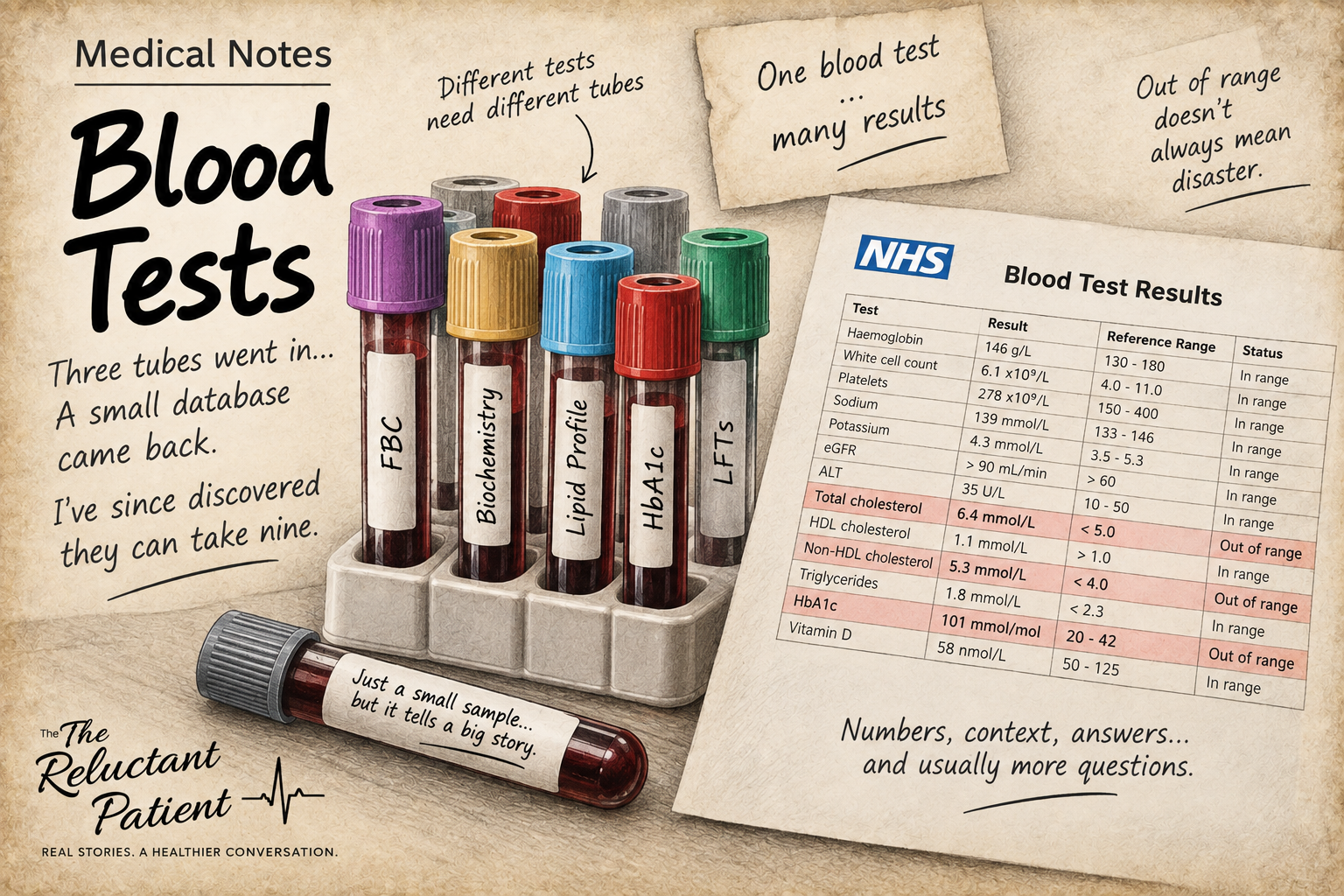
Three tubes of blood went in. A small database of results came back. I’ve since discovered they can take nine.
“We’ll do some bloods.”
This sounds singular.
It isn’t.
At The MoT, I watched three tubes fill up. That seemed quite sufficient.
I’ve subsequently had a blood test involving nine.
By that point I was beginning to wonder whether I was the patient or the donor.
The reassuring part is that the number of tubes doesn’t correspond to the number of things being tested. Three tubes can produce a surprisingly large collection of results.
Which explains why my NHS App suddenly had rather a lot to tell me.
Why do they need more than one tube?
Blood isn’t simply put into identical empty tubes and sent off to the laboratory.
Different tests need the sample to be collected and handled in different ways.
Some tubes contain substances that prevent the blood from clotting. Others allow it to clot so that the liquid serum can be separated. Different additives are used depending on what the laboratory needs to measure.
This is why blood collection tubes have different coloured tops.
The colour helps identify the type of tube and what’s inside it.
So when somebody reaches for another tube, it doesn’t necessarily mean:
Another tube = another test.
It may simply mean that the next group of tests needs the blood prepared differently.
Blood, plasma and serum
This is where some terminology starts appearing.
Whole blood is essentially the blood as collected, containing the blood cells and the liquid surrounding them.
Plasma is the liquid component of blood when clotting has been prevented.
Serum is the liquid left after blood has been allowed to clot.
Different laboratory tests use different types of sample.
Which explains why some results are described as things like plasma glucose or serum cholesterol.
They aren’t different varieties of glucose and cholesterol.
They’re telling you what sort of sample was tested.
How do three tubes produce all those results?
Because one tube can be used for multiple tests.
And some of those tests themselves contain multiple measurements.
A full blood count, for example, doesn’t produce one result. It measures several things associated with the cells in your blood.
Likewise, a lipid profile can produce results for total cholesterol, HDL, non-HDL, triglycerides and potentially calculated values derived from the other measurements.
Other groups of tests can look at things such as liver or kidney function.
So:
three tubes ≠ three results.
Three tubes can produce pages of the things.
The NHS App appeared to think I’d submitted a database.
What is a profile?
Some tests are grouped together because the results are useful when considered alongside one another.
You may therefore encounter names such as:
Full blood count (FBC)
Liver function tests (LFTs)
Lipid profile
Kidney function tests
These aren’t necessarily single measurements.
They’re collections of related measurements that help build a picture.
Which is why asking:
“Was my blood test normal?”
can turn out to be a surprisingly complicated question.
Which bit?
What’s a reference range?
When results arrive, they’re often shown alongside a reference range.
This is the range of values the laboratory uses to help interpret that particular test.
If one of my results falls outside it, the system rather helpfully labels it:
Out of range
Which is technically informative, although not necessarily terribly reassuring.
The important word in reference range is reference. An out-of-range result doesn’t automatically mean that something is seriously wrong. It needs to be interpreted alongside the test itself, how far outside the range it is, other results and the wider clinical picture.
The important word here is reference.
It isn’t necessarily a border between:
HEALTHY
and
DOOMED.
Reference ranges are usually based on the distribution of results seen in a reference population, and laboratories can use slightly different ranges depending on the test, equipment and methods being used.
That means a result just outside the range doesn’t automatically mean you’ve got something wrong with you.
Likewise, being inside every reference range doesn’t necessarily prove that everything is perfect.
Annoyingly, somebody still has to interpret the numbers.
So should I worry about an out-of-range result?
Not necessarily.
But neither should you simply ignore it.
This is where context matters . . .
A healthcare professional may consider how far outside the range something is, previous results, other measurements, symptoms, medicines and other health conditions.
Sometimes several apparently uninteresting results become important when looked at together.
Sometimes one conspicuously abnormal result demands rather more attention.
And sometimes a flagged result isn’t the thing the doctor is most concerned about.
I discovered this myself.
I noticed the cholesterol
Among the results from The MoT, even I noticed that my cholesterol wasn’t looking particularly wonderful.
But it wasn’t the result that prompted the important conversation.
My blood sugar had rather spectacularly stolen the show.
That didn’t mean the cholesterol didn’t matter. It came back into the conversation later.
It meant that among several things worth discussing, there was something rather more pressing to deal with first.
A red number in an app doesn’t know your priorities.
Your doctor hopefully does.
Are all the results actually measured?
Not necessarily.
This is something I hadn’t appreciated until I started looking more closely at my results.
Some values can be calculated from other measurements.
For example, non-HDL cholesterol can be calculated by subtracting HDL cholesterol from total cholesterol.
So even within the small database appearing in the NHS App, not every number necessarily represents a separate laboratory measurement.
Some are the result of doing maths with the others.
Finally, a bit of medicine I understand.
Why do the results appear at different times?
Because the tests aren’t necessarily all performed in the same place, on the same equipment or using the same process.
Some routine tests can be completed quickly.
Others take longer or may be sent to a specialist laboratory.
So results from one blood-taking appointment can appear at different times.
This creates another entertaining feature of having access to your own results online:
Result available.
What’s that mean?
Another result available.
Is that related?
Another result available.
Should somebody be ringing me?
Sometimes the clinical conversation arrives after the numbers do.
Do I need to prepare for a blood test?
Sometimes.
For many blood tests there is nothing particularly special to do beforehand.
Others may have specific instructions — perhaps concerning food, drink, medicines or the timing of the test.
The important thing is to follow the instructions given for that particular blood test, rather than assuming the rules from the last one still apply.
If you’ve been told to fast, for example, there will be a reason for it.
Don’t decide that breakfast probably won’t count.
Why nine tubes?
Because apparently three wasn’t impressive enough.
More seriously, the number of tubes depends on which tests have been requested and what samples those tests require.
If several different types of sample are needed, more tubes may be necessary.
The actual amount of blood in an individual tube is fairly small, although nine of them lined up on a tray does make this fact considerably less reassuring.
I survived.
They even left some in me.
What happens after the blood is taken?
The samples are labelled so they can be matched to the patient and the requested tests, then sent to the laboratory.
Depending on the test, the sample may be separated, processed and analysed by laboratory equipment before the results are checked and reported back.
Those results then become part of your medical record and may appear in services such as the NHS App.
Which brings us to another problem entirely.
Having access to the numbers and understanding the numbers are not necessarily the same thing.
That’s why quite a few of them are gradually acquiring their own Medical Notes.
Blood tests and The Reluctant Patient
Blood tests become rather important from The MoT onwards.
What began as a routine health check produced results involving cholesterol, blood sugar and several other measurements.
And one of them resulted in a phone call I wasn’t expecting:
“I’m afraid you’ve got diabetes.”
The blood test had done its job.
The Reluctant Patient now had considerably more questions.
From the Case Files
4.0.0 The MoT
Three tubes of blood and one thoroughly unexpected result.
Related Medical Notes
Cholesterol
One blood test. Rather more cholesterol numbers than I was expecting.