
Even I noticed this one in the blood results. Unfortunately, “cholesterol” turned out to be several numbers rather than one.
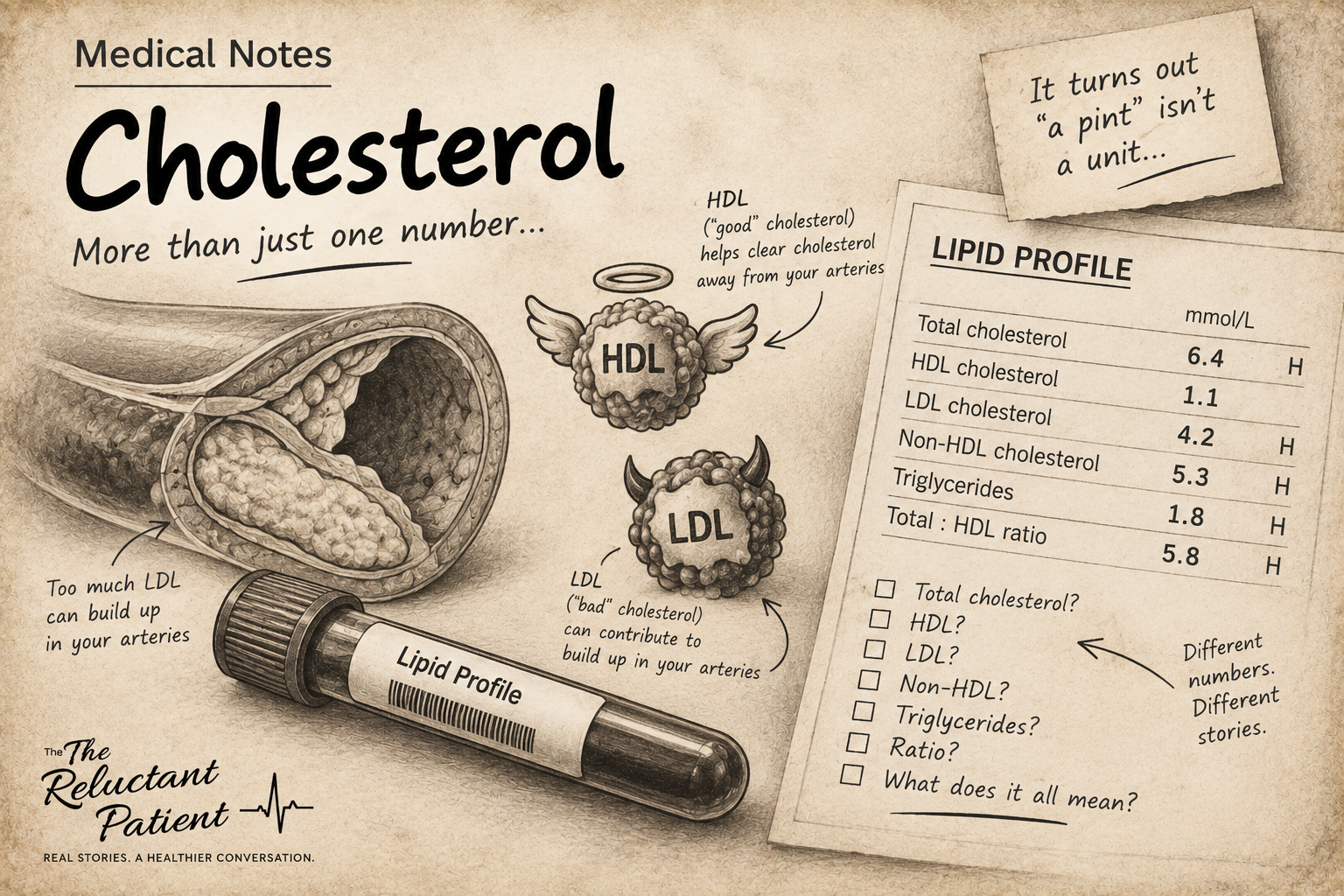
When the results from The MoT started appearing, there was quite a lot to take in.
Most dramatically, there was the blood sugar.
But there was another result that even The Reluctant Patient managed to spot.
Cholesterol.
It was high.
I knew enough about cholesterol to recognise that probably wasn’t a good thing.
What I didn’t know was that asking:
“What’s my cholesterol?”
doesn’t necessarily have a one-number answer.
What actually is cholesterol?
Cholesterol is a fatty substance — a lipid — found in the blood.
Despite its reputation, cholesterol isn’t inherently bad. The body needs it: among other things, it’s used in cell membranes and to make hormones. Much of the cholesterol in our bodies is made by the liver.
The problem is having too much of the wrong cholesterol circulating in the blood.
Over time, this can contribute to fatty deposits building up in arteries, increasing the risk of cardiovascular disease such as heart attack and stroke.
And, rather inconveniently, high cholesterol doesn’t normally make you feel ill.
You find it with a blood test.
Good cholesterol and bad cholesterol
This is the explanation I’d heard before.
There is:
good cholesterol
and
bad cholesterol.
That’s useful shorthand, although the real explanation is slightly more complicated.
Cholesterol doesn’t travel around the bloodstream by itself. It’s carried in particles called lipoproteins.
Two names you’ll commonly encounter are:
HDL — high-density lipoprotein
and
LDL — low-density lipoprotein.
HDL helps transport cholesterol away from tissues and arteries towards the liver, so it’s acquired the nickname “good cholesterol”.
LDL carries cholesterol out to cells around the body. Too much LDL can contribute to cholesterol building up in artery walls, hence “bad cholesterol”.
Good and bad.
I can cope with that.
Unfortunately, the blood results don’t stop there.
Total cholesterol
Total cholesterol is essentially the overall amount of cholesterol being carried in your blood.
For healthy adults, below 5 mmol/L is commonly used as a general guide.
That doesn’t mean:
4.9 = everything’s fine
and
5.1 = impending doom.
It’s a guide, and total cholesterol doesn’t tell you how that cholesterol is divided between the different types.
Which is why the other numbers matter.
Non-HDL cholesterol
This is one that has subsequently appeared quite prominently in my results.
Fortunately, the calculation is pleasingly straightforward:
Non-HDL cholesterol = total cholesterol − HDL cholesterol
In other words, remove the “good” HDL from the total and you’re left with the cholesterol carried in the other particles, including LDL.
For a generally healthy adult, below 4 mmol/L is commonly given as a guide.
Lower is generally better.
And unlike some of the calculations appearing in my medical records, I can actually do this one myself.
And LDL?
LDL cholesterol makes up much of that non-HDL figure.
A general guide for healthy adults is below 3 mmol/L.
But there’s an interesting wrinkle.
Depending on the laboratory, LDL may be calculated from the other lipid results rather than directly measured.
So we’ve now got blood-test numbers calculated from other blood-test numbers.
The NHS App is starting to look suspiciously like a spreadsheet.
There’s a ratio too?
Of course there is.
You may also see something like:
Total cholesterol : HDL ratio
This compares your total cholesterol with your HDL cholesterol and can be used as part of assessing your risk of cardiovascular disease.
Generally, a lower ratio is preferable.
But it isn’t simply another pass/fail cholesterol score. HEART UK notes that the ratio can sometimes look reassuring because HDL is high even when LDL or non-HDL cholesterol remains high.
So apparently even the number specifically designed to make the other numbers easier to interpret needs interpreting.
Excellent.
And triglycerides?
Triglycerides often appear alongside cholesterol results.
They’re another type of fat in the blood, but they aren’t cholesterol.
The body uses triglycerides as an energy source and can also store them for later. High levels can contribute to cardiovascular risk, so they’re normally included in a lipid profile alongside cholesterol.
So when somebody says they’ve had their “cholesterol checked”, the laboratory may actually be reporting quite a collection:
Total cholesterol
HDL
LDL
Non-HDL
Total cholesterol:HDL ratio
Triglycerides
I was beginning to understand why the NHS App had so many numbers in it.
So what’s a good cholesterol result?
This is where I’m going to resist producing a handy little table and pretending everybody should achieve exactly the same figures.
There are general guides for healthy adults.
But cholesterol isn’t interpreted in isolation.
Age, blood pressure, smoking, diabetes, family history and existing cardiovascular disease can all affect somebody’s overall risk and the levels clinicians may want them to achieve.
Someone already at increased cardiovascular risk may therefore be given a different target from somebody otherwise considered low risk.
Which brings us back to my blood results.
Even I noticed it
My cholesterol result didn’t cause The Phone Call.
Diabetes rather stole the show.
But I had access to the results and noticed that the cholesterol wasn’t looking particularly wonderful either.
Interestingly, it wasn’t the thing my GP initially wanted to discuss.
And that illustrates something useful about seeing your own blood-test results.
The fact that a number is outside a reference range doesn’t necessarily tell you how important it is compared with everything else that’s going on.
I’d just unexpectedly developed diabetes.
There was already concern about my blood pressure.
My weight and BMI weren’t exactly winning prizes.
There were liver questions lurking in the background.
In that context, cholesterol was another part of a bigger picture.
Later, when it became apparent that I was getting the diabetes under control, the cholesterol received rather more attention.
And eventually…
more pills.
But we’ll save those for another Medical Note.
What can affect cholesterol?
There isn’t necessarily one cause.
Diet — particularly saturated fat — physical inactivity, excess weight, smoking and alcohol can all play a part.
So can age, some medical conditions and some medicines.
And genetics matter too. High cholesterol can run in families, including a specific inherited condition called familial hypercholesterolaemia.
Once again, the medical explanation turns out to be slightly more complicated than:
You’ve eaten too many fry-ups.
Although I’m reasonably confident nobody is going to prescribe more fry-ups.
Why does it matter?
High cholesterol usually has no symptoms.
You can wander around feeling perfectly normal while cholesterol contributes over time to narrowing and stiffening of arteries. That increases the risk of cardiovascular disease, including heart attacks and strokes.
That’s why it gets measured alongside things such as blood pressure, weight and blood sugar.
None of which necessarily hurt.
All of which had suddenly developed opinions about me.
From the Case Files

4.0.0 The MoT
A routine health check, some blood tests and considerably more information than I had been expecting.