
Red eye, sore eye, gunk coming out of it. “Eye infection” sounds straightforward enough. Unfortunately, eyes have other ideas.
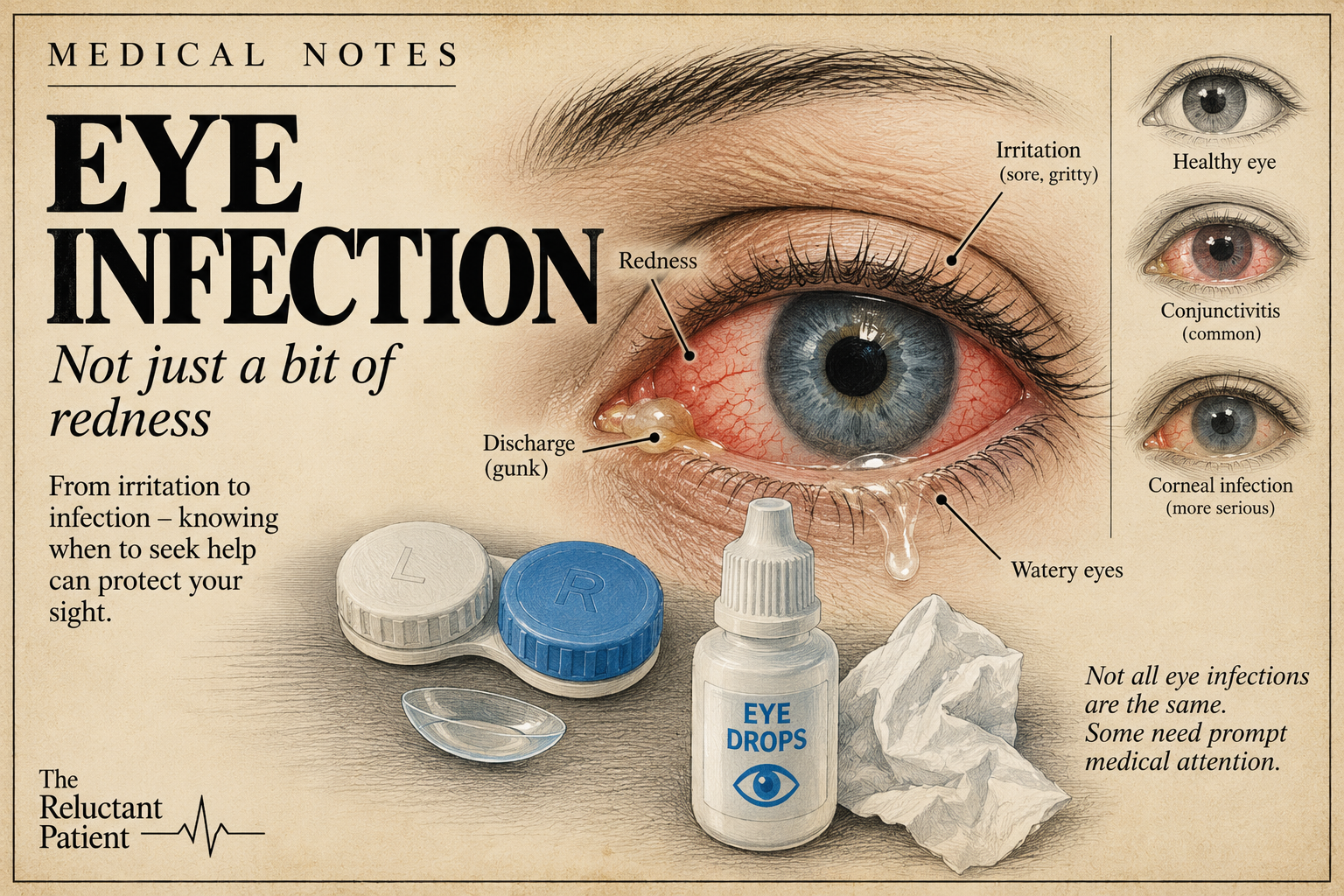
“Eye infection” is one of those wonderfully useful phrases that sounds considerably more precise than it actually is.
Your eye is red.
It’s sore.
It might be watering or producing discharge.
Therefore:
Eye infection.
Possibly.
The problem is that several different parts of the eye can become infected or inflamed, for different reasons and with very different levels of seriousness.
The Reluctant Patient discovered this after removing a contact lens that had been left in for considerably longer than recommended.
My eye looked infected.
So I treated it like an eye infection.
First stop: the pharmacy
I went to Boots.
This wasn’t quite as reckless as it might sound.
Many red or irritated eyes are caused by relatively minor problems, and pharmacists can advise on common eye complaints and whether something needs further medical attention.
I came away with an eyewash intended to help clean the eye.
Then I waited.
Twenty-four hours later, the eye wasn’t getting better.
At that point, even The Reluctant Patient decided somebody should actually look at it.
That turned out to be a good decision.
What is an eye infection?
The eye isn’t one single structure.
There’s the conjunctiva, the thin membrane covering the white of the eye and the inside of the eyelids.
There’s the cornea, the transparent surface at the front through which you see.
There are the eyelids, tear system and other structures around the eye.
Different microorganisms can also cause infections, including bacteria, viruses and, less commonly, fungi or parasites.
So saying you’ve got an “eye infection” is a little like saying you’ve got a problem with your car.
Useful starting point.
More information required.
Conjunctivitis
Probably the best-known eye infection is conjunctivitis.
The conjunctiva becomes inflamed, causing symptoms that can include redness, watering, irritation and discharge.
But even conjunctivitis isn’t necessarily an infection.
It can be caused by bacteria or viruses, but allergies and irritation can produce conjunctivitis too.
Many cases are relatively minor and improve without specialist treatment.
Which is probably why a red eye can initially seem like something that can safely be left to its own devices.
Sometimes it can.
Sometimes it can’t.
When the cornea gets involved
This is where things become more interesting.
And not in a good way.
An infection of the cornea is known as microbial keratitis. Bacteria are a common cause, although other microorganisms can be responsible.
Because the cornea is the clear surface through which light enters the eye, infection and subsequent scarring can potentially affect sight.
It can also cause a corneal ulcer.
Contact-lens wear is an important risk factor for microbial keratitis, particularly where lenses aren’t used or cared for as recommended.
Suddenly:
red eye + contact lenses
deserves rather more attention than:
red eye.
Did I have microbial keratitis?
I don’t know.
And that’s important.
There was concern about infection, and I had a corneal ulcer, but I don’t have enough information to retrospectively give myself a more specific diagnosis.
So I’m not going to.
Microbial keratitis explains why infection involving the cornea can be serious. It doesn’t mean that’s definitely what happened to me.
What I do know is that my eye wasn’t improving and, when it was properly examined, there was damage to the cornea.
That was enough to move matters beyond my bottle of eyewash.
Contact lenses change things
Contact lenses sit directly on the cornea.
That’s rather convenient when they’re correcting your eyesight.
It’s rather less convenient when something goes wrong.
Contact-lens wear increases the risk of certain corneal infections. Poor lens hygiene, wearing lenses for longer than recommended, sleeping in lenses that aren’t intended for overnight wear and exposing lenses to water can increase that risk.
I had already removed my contact lens before seeking medical attention.
Unfortunately, removing the evidence doesn’t necessarily remove the consequences.
When should a red eye be taken seriously?
Most red eyes aren’t medical catastrophes.
But there are symptoms that make proper assessment more important.
These include significant eye pain, changes or loss of vision, sensitivity to light, severe redness, injury to the eye, or symptoms that are worsening rather than improving.
And contact-lens wearers with a painful red eye warrant particular caution because of the risk of corneal infection.
That doesn’t mean every contact-lens wearer with a red eye is about to go blind.
It means it’s not a particularly good situation in which to prove how reluctant a patient you can be.
What about eye drops?
That depends entirely on what’s wrong.
An eyewash or lubricating drops may help with some relatively minor irritation, but they don’t magically treat every possible cause of a red eye.
Antibiotic drops may be used for some bacterial infections. Other causes require different treatment.
And because some serious eye conditions can initially look rather similar to less serious ones, choosing increasingly impressive bottles from the pharmacy shelf isn’t necessarily a substitute for finding out what’s wrong.
In my case, treatment eventually became rather more specific.
Which brings us to another Medical Note:
Brolene.
Apparently even obtaining the correct eye drops can become an adventure.
So was going to Boots wrong?
No.
This is an important distinction.
I had what appeared to me to be an irritated or infected eye. I sought advice and tried an appropriate pharmacy product.
Then I watched what happened.
It didn’t improve.
So I escalated.
That’s rather different from repeatedly treating a deteriorating eye yourself while refusing to let anybody examine it.
The Reluctant Patient has made plenty of questionable medical decisions.
I’m not sure this was actually one of them.
What happened next?
When my eye was properly examined, the infection wasn’t the only concern.
There was damage to the cornea.
A corneal ulcer.
That was something I hadn’t known was there and couldn’t have diagnosed by looking in the mirror.
And that discovery changed the course of the whole episode.
The eye needed treatment.
The possibility of damage to my sight suddenly became rather more real.
And The Reluctant Patient discovered that there are circumstances in which:
“I’ll give it another day.”
isn’t necessarily the best treatment plan.
Fortunately, this time I’d already decided not to.
From the Case Files
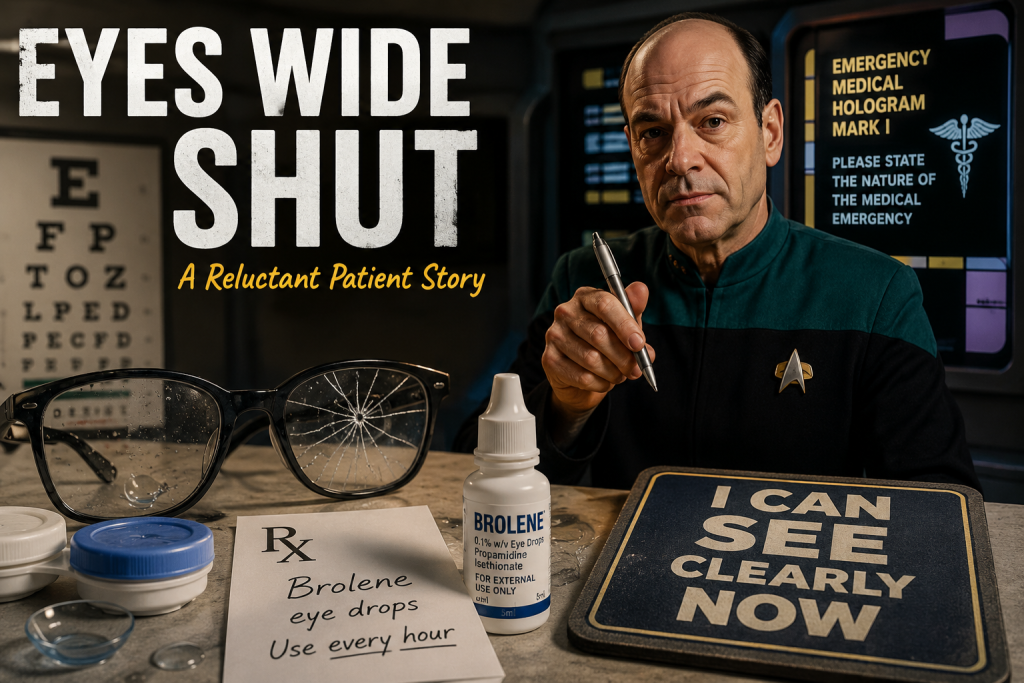
3.0.0 Eyes Wide Shut
A contact lens, an unhappy eye and the gradual realisation that this probably wasn’t going to fix itself.
Related Medical Notes
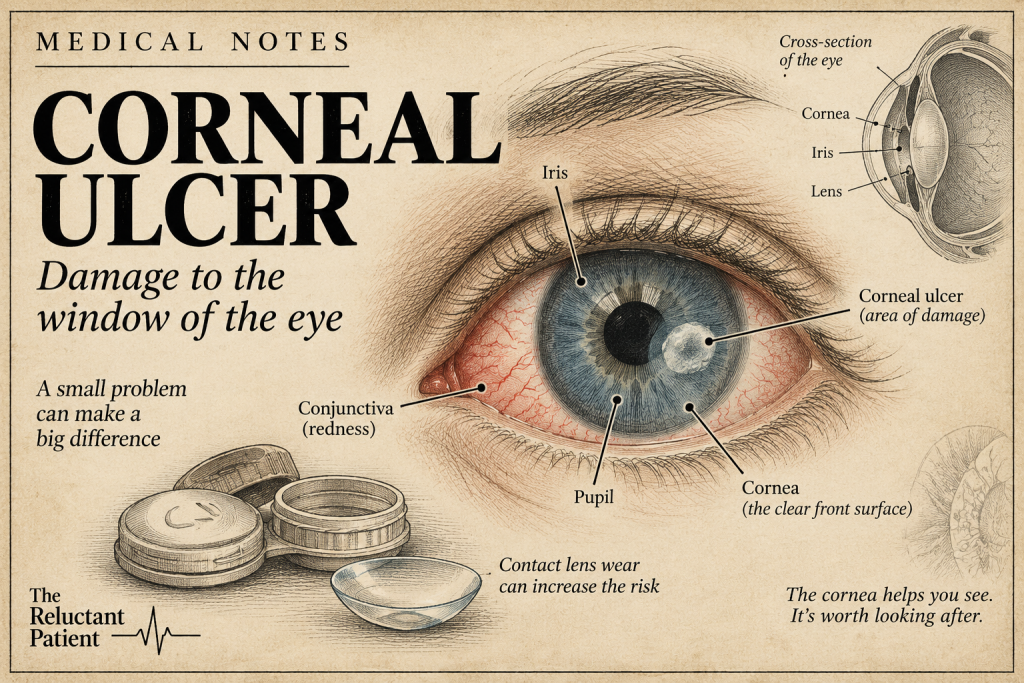
Corneal Ulcer
What they found when somebody who knew what they were looking at examined the eye.
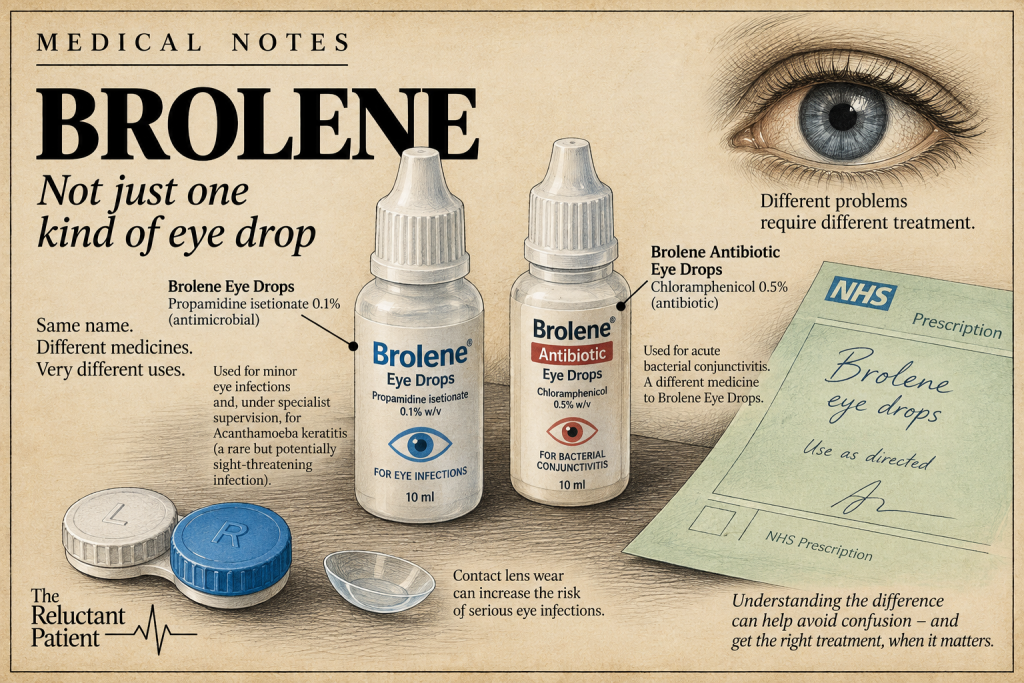
Brolene
The eye drops that became considerably more interesting once I actually needed them.