
The doctor thought my sight might be in danger and handed me an urgent prescription for Brolene. Finding the right eye drops proved rather less straightforward.
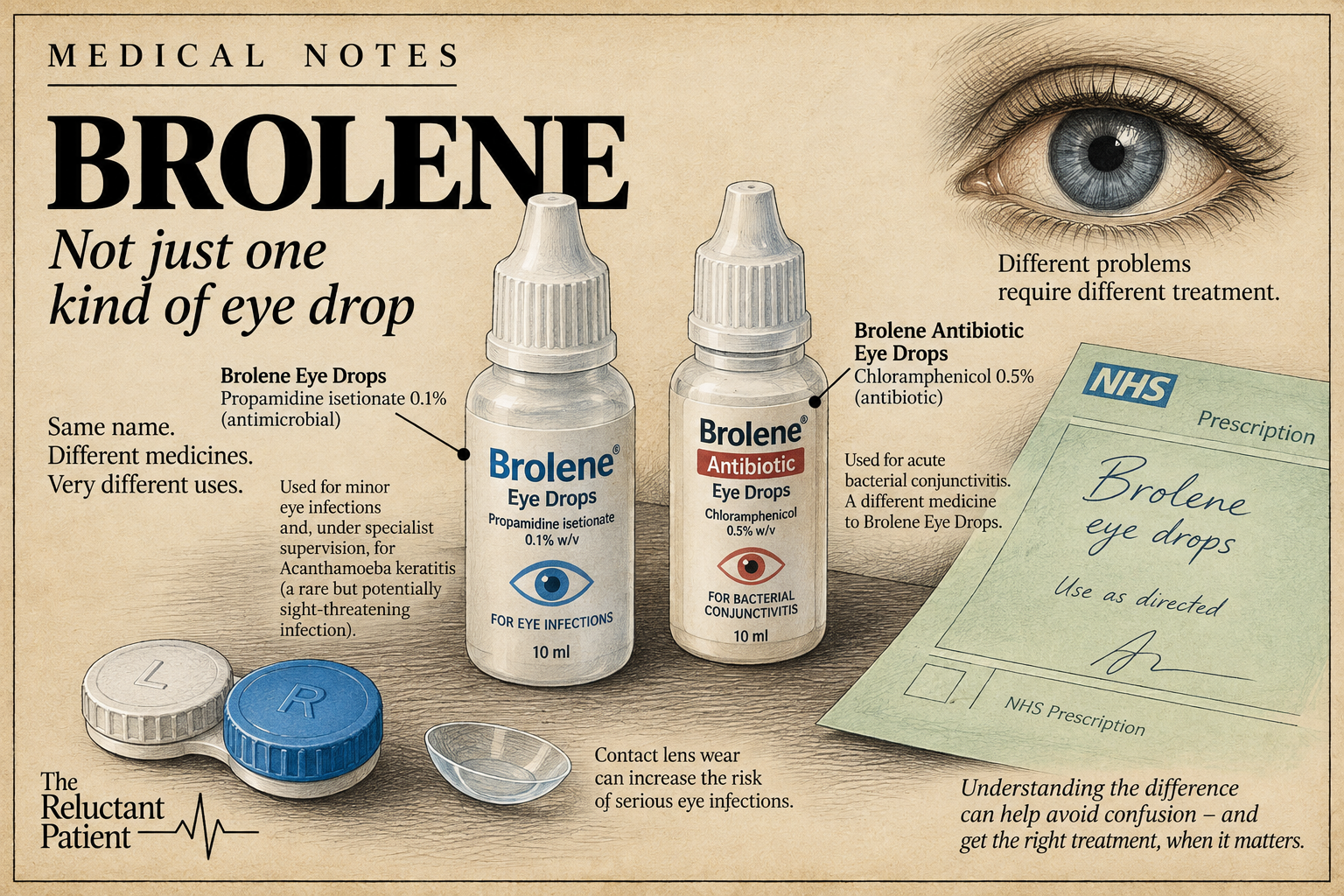
There are two different Brolene eye drops.
Let’s get that out of the way immediately, because it gets confusing remarkably quickly.
Brolene Eye Drops contain propamidine isetionate 0.1%.
Brolene Antibiotic Eye Drops contain chloramphenicol 0.5%.
Despite sharing the Brolene name and both being eye drops, they contain different medicines and have different uses.
The Brolene in this story was:
Brolene Eye Drops — propamidine isetionate 0.1%.
And somebody wanted me to get hold of it rather urgently.
Things had become rather more serious
I’d originally thought I had an eye infection.
I’d removed the contact lens I’d left in for far too long, tried an eyewash from Boots and, when things weren’t improving the following day, sought medical help.
Then somebody actually looked at my eye.
There was a corneal ulcer.
And suddenly there was considerably more concern about what was happening.
The doctor was thinking in terms of hours to save my sight.
That’s quite an effective way of getting The Reluctant Patient’s attention.
I was given a green prescription slip for Brolene and sent off to get the eye drops.
Urgently.
Finding Brolene
Armed with my prescription, I went to a pharmacy.
No Brolene.
Another pharmacy.
Still no Brolene.
This was becoming slightly alarming.
Normally, being told that a pharmacy doesn’t have something is an inconvenience.
When you’ve just been told that there may be a rather limited window in which to prevent permanent damage to your eyesight, it feels somewhat different.
Eventually, I did get hold of the drops.
At the time, though, Brolene was simply the name written on the prescription.
Looking into what was actually in that bottle makes the whole episode rather more interesting.
So what is Brolene?
The active ingredient in Brolene Eye Drops is propamidine isetionate 0.1%.
Propamidine is an antimicrobial medicine. The licensed Brolene product information describes it as a disinfectant with activity against some microorganisms and says it can be used for minor eye infections such as conjunctivitis and blepharitis.
And this is where things initially seem a little odd.
I’d just been given an urgent prescription by a doctor who was worried about my sight.
Yet the same Brolene Eye Drops are also a pharmacy medicine used for relatively minor eye infections.
How can both of those things make sense?
Well…
Propamidine has another use
Propamidine also has a specialist role in treating a rare but potentially sight-threatening infection called Acanthamoeba keratitis.
Acanthamoeba is a microscopic organism that can infect the cornea. Contact-lens wear is an important risk factor.
And this is where the Sussex NHS formulary gets particularly interesting.
It says propamidine has little value for bacterial infections but is used by specialists to treat Acanthamoeba keratitis, describing the condition as rare but potentially sight-threatening. It also identifies this as an unlicensed indication.
So the same active ingredient can appear in an ordinary pharmacy medicine for minor eye infections and also have a specialist use in the treatment of something considerably more serious.
Suddenly my little bottle of eye drops looked rather less little.
Did I have Acanthamoeba keratitis?
I don’t know.
This distinction is important.
I had:
contact-lens use;
an unhappy red eye;
a corneal ulcer;
concern about infection;
a doctor worried about saving my sight;
and
a prescription for propamidine.
Those facts make Acanthamoeba keratitis relevant when trying to understand why this medicine might have been prescribed.
They don’t amount to a diagnosis.
I don’t remember being told that I definitely had Acanthamoeba keratitis, and without a medical record saying that, I’m certainly not going to diagnose myself with it retrospectively.
It may have been suspected.
It may have been something the doctor wanted to treat against while there was still time.
Or there may have been another reason for choosing propamidine.
I don’t know.
What I do know is that the doctor wasn’t treating the situation as an ordinary case of conjunctivitis.
Licensed and unlicensed uses
This sounds slightly alarming until you understand what it means.
A medicine is licensed for particular uses based on its marketing authorisation.
Doctors can also use medicines outside those licensed terms when, in their clinical judgement, that’s appropriate. This is commonly described as off-label or unlicensed use, depending on the circumstances.
It doesn’t mean somebody has obtained a suspicious bottle of eye drops from a bloke down the pub.
In this case, ordinary Brolene Eye Drops are licensed for minor eye infections.
The specialist use of propamidine for Acanthamoeba keratitis is different, and the Sussex formulary explicitly identifies that use as unlicensed.
Same medicine.
Very different circumstances.
And then there’s the other Brolene
Just when we’d got that straight…
There is also Brolene Antibiotic 0.5% Eye Drops.
That contains chloramphenicol, not propamidine.
Chloramphenicol is an antibiotic and Brolene Antibiotic is indicated for acute bacterial conjunctivitis.
So:
Brolene Eye Drops
Propamidine isetionate 0.1%
Brolene Antibiotic Eye Drops
Chloramphenicol 0.5%
Not interchangeable names for the same thing.
Not even the same active ingredient.
This is why the first thing this Medical Note needed to do was establish which bloody Brolene we’re talking about.
Brolene, GoldenEye and brand names
There’s another wrinkle.
Brolene is the brand.
Propamidine isetionate is the active ingredient.
The Sussex formulary also identifies GoldenEye eye drops as an over-the-counter propamidine product alongside Brolene.
GoldenEye.
Of course.
I’d already managed to call the story Eyes Wide Shut.
Apparently James Bond wanted a part too.
This also illustrates why knowing the active ingredient in a medicine can sometimes be considerably more useful than knowing only the brand name.
Why was it difficult to find?
I don’t know.
And I don’t think we should manufacture an explanation just because one would make a satisfying story.
I had a prescription for Brolene and more than one pharmacy couldn’t immediately supply what had been prescribed.
It could have been a local stock issue.
It could have been availability at the time.
The brand name may or may not have contributed.
I simply don’t have enough information to say.
What mattered considerably more at the time was that I had been told the treatment was urgent.
So “we haven’t got it” wasn’t really the answer I wanted to hear.
What about contact lenses?
Brolene Eye Drops contain the preservative benzalkonium chloride.
The product information says the drops aren’t suitable for use with hard or soft contact lenses and advises removing contact lenses before using them.
That wasn’t going to be a problem for me.
By this stage I had developed a considerably less enthusiastic attitude towards putting another contact lens anywhere near the affected eye.
Closing the stable door after the horse had bolted, perhaps.
But at least the horse wasn’t going back in.
Can you just buy Brolene yourself?
Brolene Eye Drops containing propamidine are a pharmacy medicine for their ordinary licensed use.
But that’s not the lesson to take from my experience.
The fact that a medicine can be supplied by a pharmacist doesn’t mean you can diagnose and treat a potentially serious corneal infection yourself.
Brolene’s own product information says medical advice should be obtained if symptoms worsen or there hasn’t been significant improvement after two days. Disturbed vision is also specifically identified as a reason to stop treatment and consult a doctor.
And if someone has a painful red eye, changes in vision or problems associated with contact lenses, there may be considerably more going on than a minor eye infection.
In my case there was.
That’s how I ended up with the prescription in the first place.
So what was Brolene doing in my story?
At the time:
Brolene was the eye medicine the doctor urgently wanted me to use.
That was really all I needed to know.
Looking back, there’s a lot more behind that name.
There are two different Brolene products.
Mine contained propamidine, not chloramphenicol.
Propamidine has an ordinary licensed role in minor eye infections.
It also has a specialist role in treating Acanthamoeba keratitis, a rare infection capable of threatening sight.
I can’t tell you which precise diagnosis was running through the doctor’s mind.
But I can tell you what was running through mine.
I’d gone from:
My eye looks a bit infected.
to:
There might be hours to save my sight.
rather quickly.
And suddenly finding a bottle of eye drops seemed quite important.
What happened next?
I got the Brolene.
My eye was treated.
And fortunately, my sight recovered.
I can’t retrospectively separate exactly what part the corneal damage, suspected infection or particular treatment played.
What I can say is that the experience changed my attitude towards my eyesight.
The Reluctant Patient can be remarkably good at assuming medical problems will sort themselves out.
The prospect of going blind proved rather harder to ignore.
It wasn’t the end of my medical misadventures.
Obviously.
But it was quite an effective warning.
From the Case Files
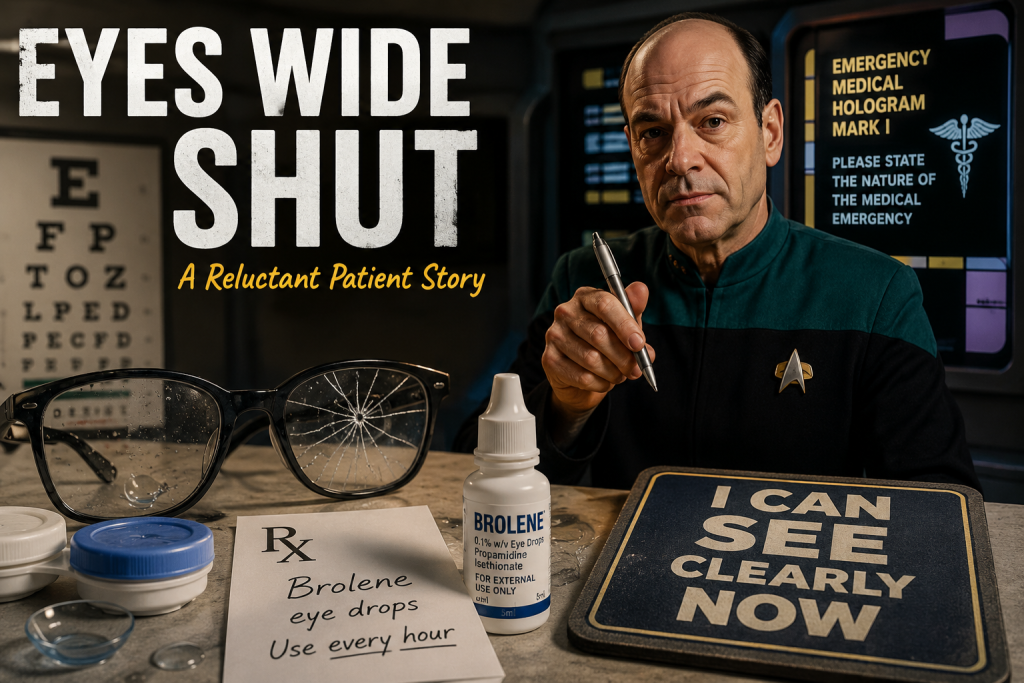
3.0.0 Eyes Wide Shut
A contact lens, an unhappy eye and the gradual realisation that this probably wasn’t going to fix itself.
Related Medical Notes
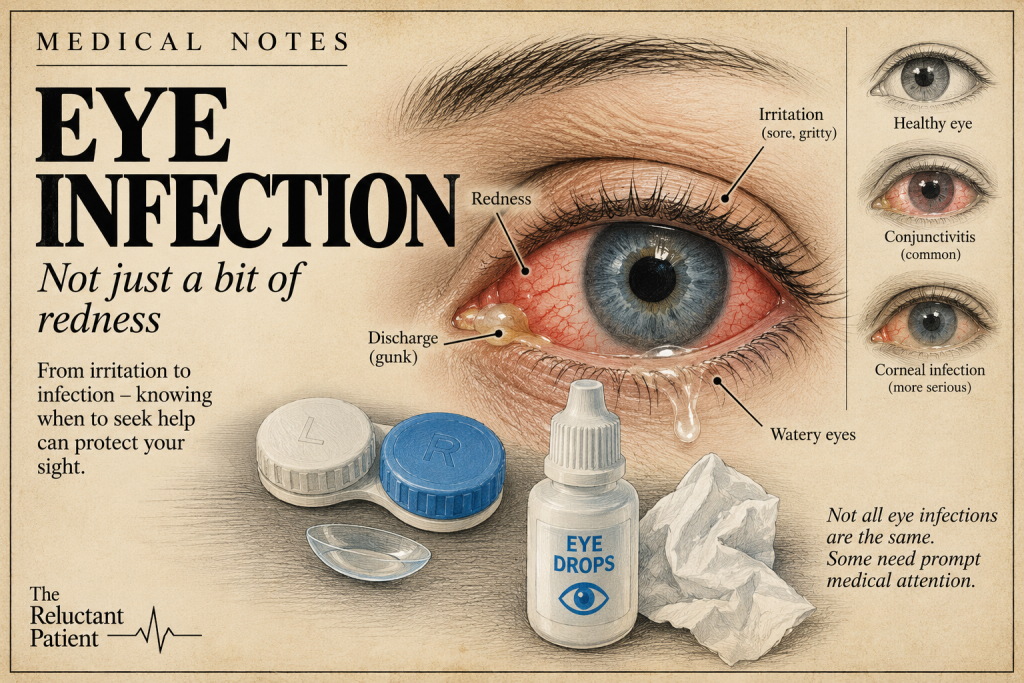
Eye Infection
What I thought was wrong — and why “eye infection” can describe problems ranging from annoying to potentially serious.
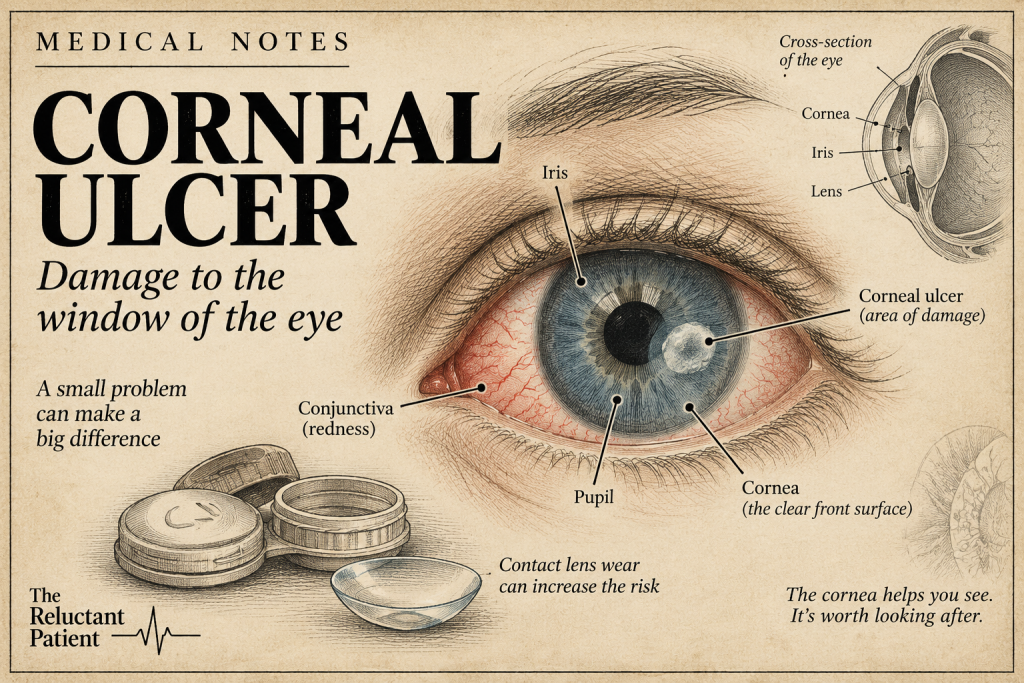
Corneal Ulcer
What they found when somebody who knew what they were looking at actually examined my eye.