
I thought I had an eye infection. Then somebody who knew what they were looking at found I’d damaged the bit of the eye I actually see through.
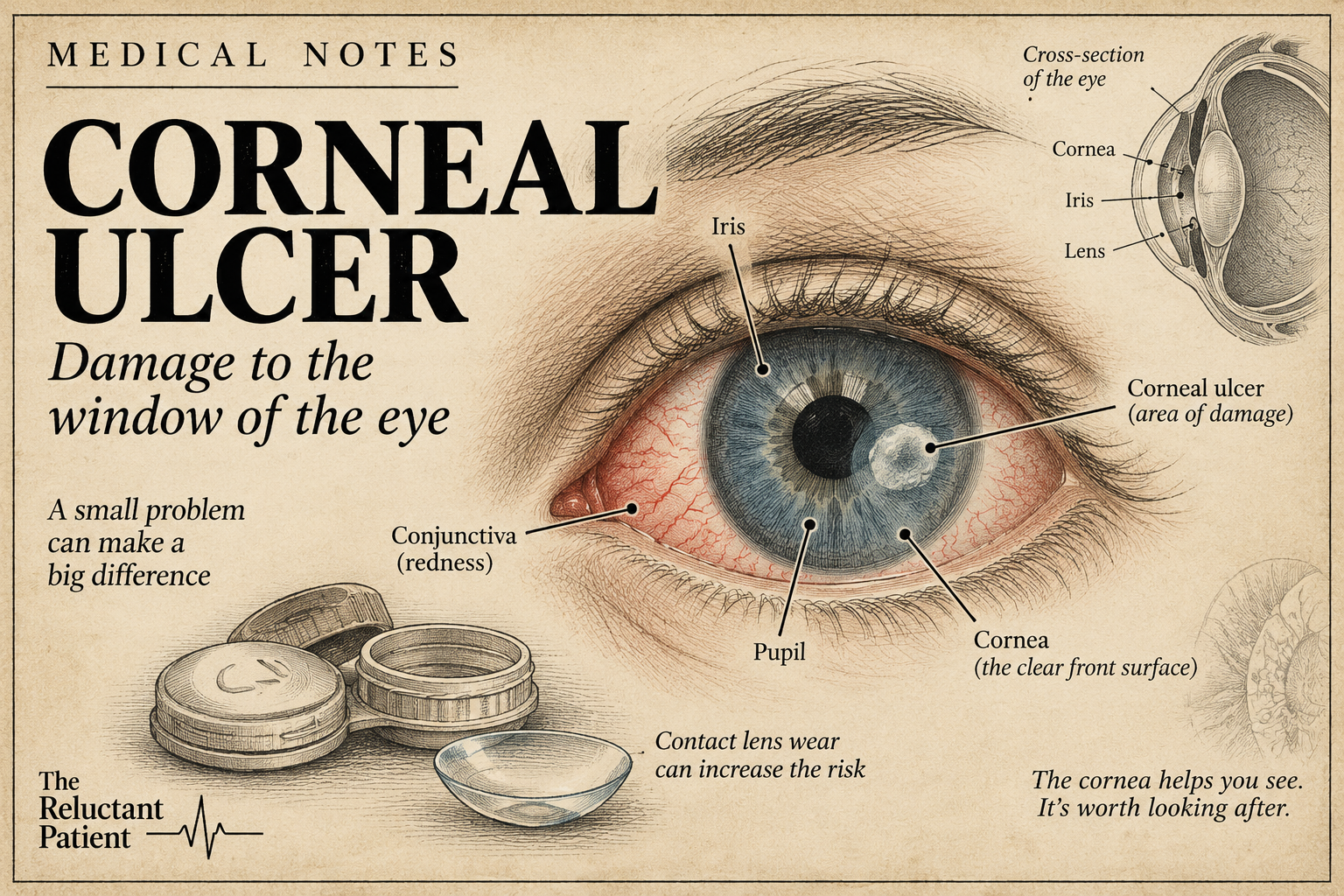
A corneal ulcer is an area of damage to the cornea — the clear surface at the front of the eye.
The cornea protects the eye and plays an important role in focusing light. It therefore isn’t something you particularly want to damage.
Unfortunately, The Reluctant Patient had been conducting an experiment in exactly that.
I thought I had an eye infection
I wore contact lenses.
More specifically, I’d left one contact lens in my eye for considerably longer than its manufacturer, an optician, an ophthalmologist or anybody possessing basic common sense would have recommended.
Eventually, I removed it.
My eye wasn’t happy.
It looked infected, so I went to Boots and came away with an eyewash intended to help clean the eye.
Twenty-four hours later, it wasn’t getting better.
That was enough even for The Reluctant Patient. I sought medical help.
I was concerned about an eye infection.
What I didn’t know was that I’d also damaged the cornea.
What is the cornea?
Look at an eye and you’ll see the coloured iris, with the pupil in the middle.
In front of both is the transparent cornea.
It’s the clear, curved surface at the front of the eye. As well as protecting the structures behind it, the cornea helps focus incoming light.
It also contains lots of nerve endings, which helps explain why damage to it can be disproportionately painful.
Think of it as the front window of the eye.
Preferably without a scratch in it.
So what’s a corneal ulcer?
A corneal ulcer is an area where the surface of the cornea has broken down.
There are different possible causes. Some ulcers are associated with infection, while others can be non-infectious.
Contact-lens wear is an important risk factor for problems affecting the cornea. Wearing lenses for too long, sleeping in lenses not intended for overnight wear and poor contact-lens hygiene can all increase the risk of corneal damage or infection.
In my case, the damaged area appeared remarkably circular and seemed to correspond rather neatly with where the contact lens had been sitting.
My interpretation was obvious:
I’d left the bloody thing in so long it had started embedding itself into my eye.
That’s my interpretation of what I saw, rather than a medical diagnosis of an embedded contact lens.
The contact lens had already been removed before I sought medical help, so I can’t establish retrospectively exactly what had happened.
I can confidently establish that leaving it in for that long was a bad idea.
How is a corneal ulcer found?
This is where seeking medical attention has a considerable advantage over staring at your own eye in a mirror.
The cornea can be examined using magnification and a slit lamp, which allows a medical professional to get a much better look at the structures at the front of the eye.
They may also use fluorescein, a dye placed into the eye. Areas where the corneal surface has been damaged take up the dye and become much easier to see under blue light.
So something you didn’t even know was there can suddenly become rather obvious.
In my case:
circular.
Rather suspiciously circular.
Why does it matter?
The cornea needs to remain transparent for you to see properly through it.
Damage to the cornea can heal, but significant damage may cause scarring. Depending on where that scarring occurs and how extensive it is, it can affect vision.
Corneal ulcers associated with infection can also become more serious if the infection progresses.
This is therefore one of those occasions where a painful or worsening eye — particularly in someone who wears contact lenses — isn’t something to experiment with indefinitely.
Changes to vision, significant pain, light sensitivity or a very red eye are also reasons to seek prompt medical assessment.
What about the infection?
That’s where things overlap.
I originally sought medical attention because I thought I had an eye infection, not because I knew I had a corneal ulcer.
Infection can cause corneal ulcers, but not every corneal ulcer is infectious. Likewise, not every eye infection involves the cornea.
In my particular adventure, infection became an important concern and eventually led to some rather interesting eye drops.
So rather than turning this Medical Note into an entire textbook on infected eyes, we’ll deal with that separately:
Eye Infection
And then:
Brolene
Because apparently asking for a bottle of eye drops can also become a story.
What happened to mine?
Fortunately, the eye was treated and my vision recovered.
But the experience did rather change my attitude towards eyesight.
Until then, The Reluctant Patient had largely regarded medical problems as irritating things that would probably go away eventually.
The possibility of permanently damaging my sight was harder to dismiss.
Going blind turns out to be quite an effective wake-up call.
Not completely effective, obviously.
There are more Case Files.
From the Case Files
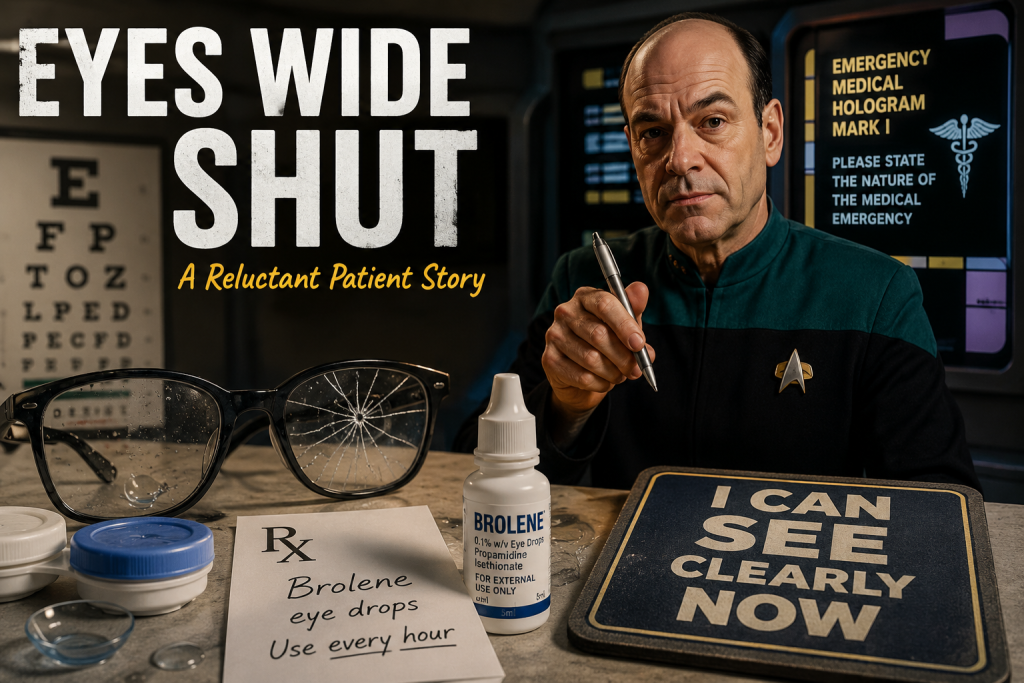
3.0.0 Eyes Wide Shut
A contact lens, an unhappy eye and the gradual realisation that this one probably wasn’t going to fix itself.
Related Medical Notes
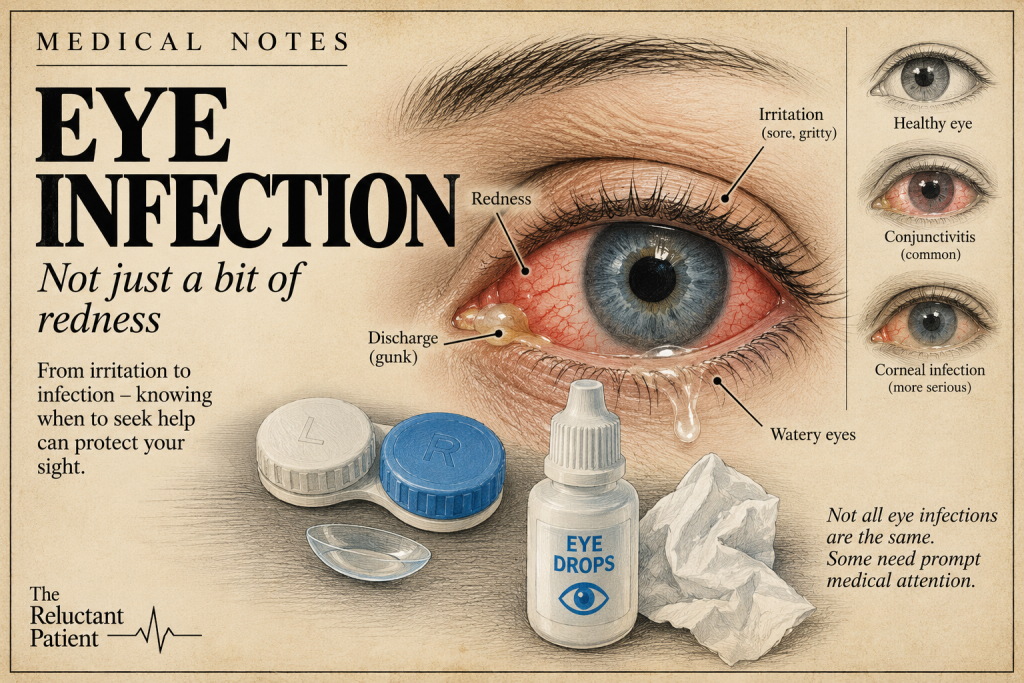
Eye Infection
I thought that was the problem. It turned out there was rather more going on.
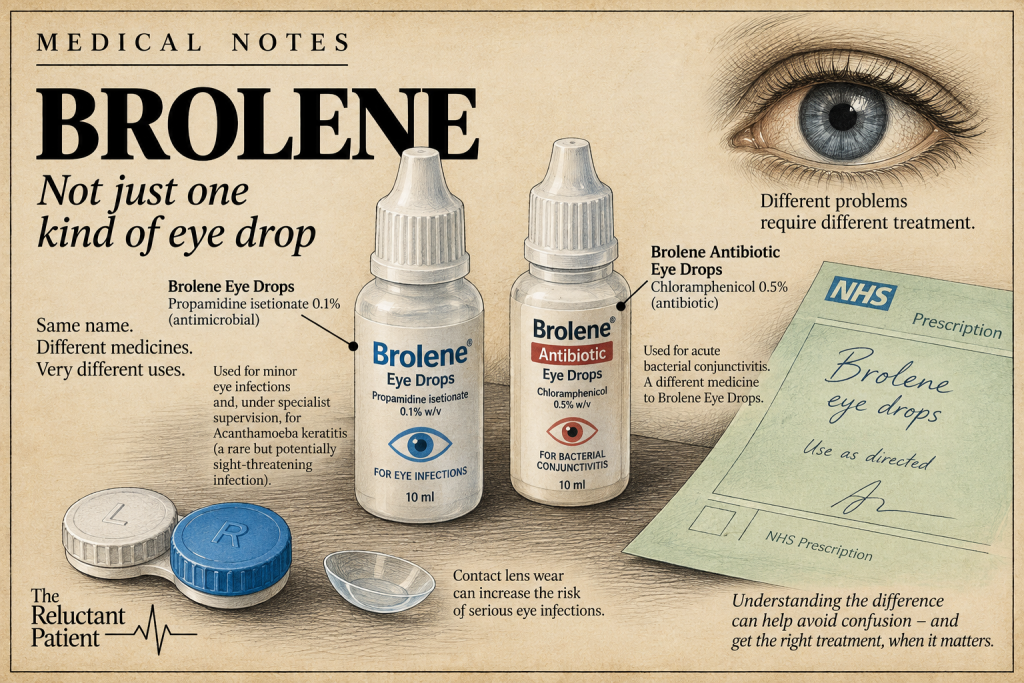
Brolene
Eye drops which became considerably more interesting once I actually needed them.