
Don’t Panic. This is excellent advice. The Reluctant Patient has occasionally had difficulty following it.
The Hitchhiker’s Guide to the Galaxy is difficult to describe.
This isn’t because nothing happens.
Rather too much happens.
It began as a BBC radio series in 1978, created and written by Douglas Adams. Then came the novels, beginning with The Hitchhiker’s Guide to the Galaxy in 1979, followed by a six-part BBC television adaptation in 1981.
There have subsequently been more books, more radio, stage productions and a 2005 film.
The Reluctant Patient has encountered several versions over the years. I’ve read the first four books – I think – and seen the film, but it’s the 1981 television series that we’re putting in the Waiting Room.
Don’t Panic
Arthur Dent is having a bad day.
He wakes up to discover that the local council intends to demolish his house to make way for a bypass.
Arthur responds by lying down in front of the bulldozer.
His friend Ford Prefect arrives with some rather more important news.
Ford isn’t actually from Guildford.
He’s from somewhere in the vicinity of Betelgeuse, and he’s been stranded on Earth for fifteen years while researching a new edition of The Hitchhiker’s Guide to the Galaxy.
More importantly, the Earth is about to be demolished.
For a bypass.
Admittedly, this one is hyperspatial.
Ford takes Arthur to the pub and attempts to explain the situation over several pints before the Vogon constructor fleet arrives and destroys the planet.
Arthur survives.
The pub doesn’t.
Nor does the rest of the Earth.
And Arthur is still wearing his dressing gown.
There is something about Arthur Dent that The Reluctant Patient finds reassuring.
Extraordinary and increasingly terrible things keep happening to him and Arthur responds with a mixture of confusion, irritation and a desire for somebody to explain what the hell is going on.
Preferably over a drink.
The Guide
Fortunately, Arthur has access to The Hitchhiker’s Guide to the Galaxy.
The Guide is an electronic book containing an enormous collection of useful – and sometimes questionably useful – information about the galaxy.
Most importantly, the words DON’T PANIC are written on its cover.
This is excellent advice.
The Reluctant Patient has occasionally had difficulty following it.
There is another potential problem with the Guide.
It isn’t necessarily right.
Entries have been contributed by various researchers travelling around the galaxy, and accuracy sometimes appears to be less important than producing something interesting enough for people to read.
The Reluctant Patient can see absolutely no parallels with looking up medical symptoms on the Internet.
None whatsoever.
Mostly harmless
The Guide originally has very little to say about Earth.
Its entire entry reads:
Harmless.
Ford has spent fifteen years researching the planet and submits a substantially expanded replacement.
After all that work, the revised entry becomes:
Mostly harmless.
That’s probably not a bad description of The Reluctant Patient.
Mostly.
Forty-two
Eventually we discover that Earth had a rather more important purpose than anybody realised.
A supercomputer called Deep Thought had spent seven and a half million years calculating the Answer to the Ultimate Question of Life, the Universe and Everything.
The answer was:
42.
Unfortunately, nobody knew what the question was.
So an even more sophisticated computer was required to calculate it.
That computer was the Earth.
Which makes its demolition somewhat inconvenient.
There’s probably something here about medical tests.
Sometimes you can have a perfectly accurate answer and still have absolutely no idea what it means.
Marvin
Then there’s Marvin the Paranoid Android.
Marvin has a brain the size of a planet.
Unfortunately, nobody gives him anything remotely interesting to do with it.
He is permanently depressed, expects the worst from everything and is usually proved right.
Arthur might be confused by the universe, but Marvin understands it.
That’s why he’s miserable.
The Reluctant Patient isn’t sure which is worse.
A towel
The Guide also explains that the most massively useful thing an interstellar hitchhiker can have is a towel.
There are many practical reasons for this.
But more importantly, if somebody sees a hitchhiker travelling around the galaxy who still knows where his towel is, they’ll assume that person must also possess all the other things required for interstellar travel.
The Reluctant Patient likes this principle.
Appear sufficiently well prepared and perhaps nobody will notice that you haven’t got the slightest idea what’s going on.
So long, and thanks for all the fish
Douglas Adams had a particular talent for taking something perfectly ordinary, applying completely logical reasoning to it, and arriving somewhere utterly ridiculous.
Bureaucracy. Planning departments. Restaurants. Computers. Towels. The number 42.
And, underneath all of it, people trying to make sense of systems far bigger and more complicated than they are.
Perhaps that’s why The Hitchhiker’s Guide to the Galaxy belongs in the Waiting Room.
A Reluctant Patient can go to work one morning thinking that everything is basically fine.
Then somebody telephones.
Suddenly there are tests, appointments, referrals, terminology you’ve never heard before and people who apparently understand rules that nobody has bothered to explain to you.
Your perfectly ordinary day has become something considerably larger.
At which point there are really only two sensible things to remember.
Know where your towel is.
And don’t panic.
From the Case Files
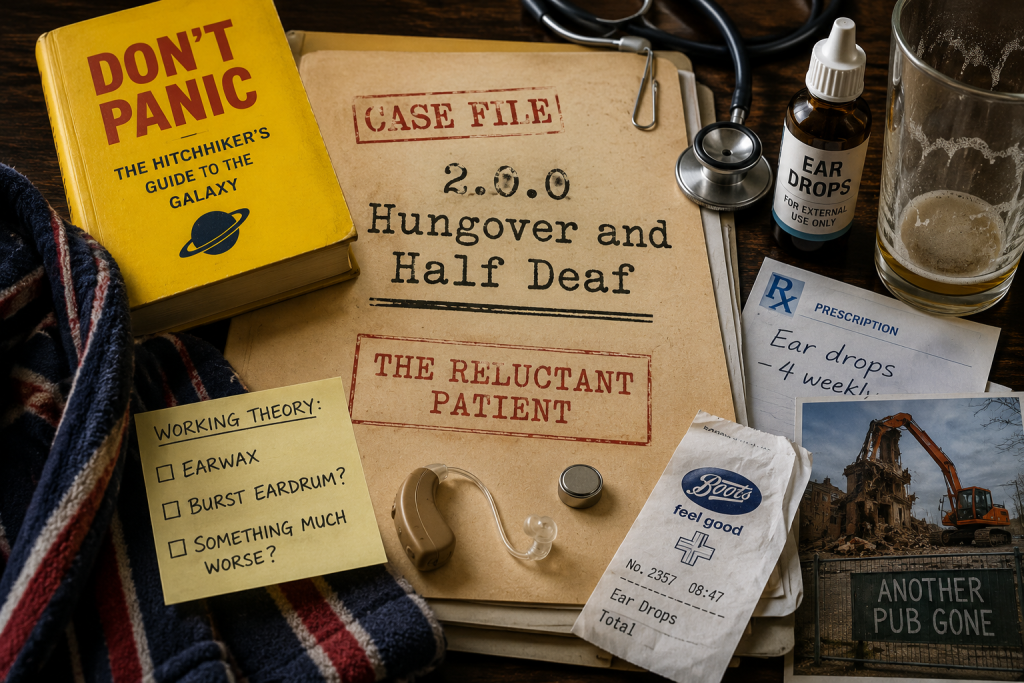
2.0.0 Hungover and Half Deaf
I woke up after a heavy night unable to hear properly out of one ear. Obviously, I assumed it was earwax. It wasn’t earwax.