
Please state the nature of the medical emergency. How long have you got?
Star Trek: Voyager is the fourth live-action television series in the Star Trek franchise and originally ran for seven series between 1995 and 2001.
The premise is fairly simple.
The USS Voyager, commanded by Captain Kathryn Janeway, is sent to find a missing Maquis ship.
It finds it.
Unfortunately, both ships also find themselves transported about 70,000 light-years across the galaxy into the Delta Quadrant.
Getting home at maximum warp will take roughly 75 years.
Bit of a bugger.
The two crews are forced to work together aboard Voyager, beginning a very long journey home through a region of space largely unknown to the Federation.
Fortunately, they’ve got a doctor.
Sort of.
Please state the nature of the medical emergency
During Voyager’s unexpected trip to the Delta Quadrant, much of the medical staff are killed.
This is inconvenient.
Fortunately, sickbay has an Emergency Medical Hologram: a computer-generated doctor intended to provide temporary assistance when the real medical staff are unavailable.
He’s switched on.
“Please state the nature of the medical emergency.”
And then nobody switches him off for seven years.
The Doctor, played by Robert Picardo, starts as a rather irritable computer programme with an encyclopaedic knowledge of medicine and a bedside manner that could probably use some work.
The Reluctant Patient can see advantages to this arrangement.
For one thing, when you’ve had enough of your doctor, you can turn him off.
Unfortunately, The Doctor gradually develops interests, opinions, friendships, ambitions and a considerable personality of his own.
So much for that idea.
I’m a doctor
The Doctor has another rather useful characteristic.
He knows what he’s talking about.
He doesn’t need to disappear and consult a book. He doesn’t need to look something up on the Internet. His programme contains an enormous medical database and the knowledge and experience of Federation medical experts.
This sounds ideal.
The problem is that he expects his patients to do what he tells them.
The Reluctant Patient is beginning to have doubts.
Worse still, The Doctor can perform scans, order treatment and complain when his patients aren’t taking proper care of themselves.
Perhaps deleting the programme would be a little excessive.
Could we just mute him?
Sickbay
There are certain advantages to healthcare in the 24th century.
Forget waiting three weeks for an appointment.
Walk into sickbay, wave a tricorder over the affected area and a doctor can apparently tell what’s wrong with you in seconds.
There are hyposprays instead of needles.
Broken bones can be fixed remarkably quickly.
Strange alien diseases that nobody has ever encountered before can usually be diagnosed, investigated and cured in about 45 minutes.
Occasionally somebody dies.
But they’ll probably be back next week.
The Reluctant Patient approves of much of this.
Particularly the lack of needles.
Seven of Nine
Then there’s Seven of Nine.
Seven was assimilated by the Borg as a child and spent much of her life as part of the Collective before being separated from it by Voyager’s crew.
The Doctor takes a particular interest in her recovery.
Removing Borg technology turns out not to be quite as simple as pulling out a few wires and sending her on her way.
Her body has adapted to it. Some implants can be removed. Others can’t. She needs continuing treatment while relearning how to function as an individual human being.
Which makes Seven’s story rather more interesting than simply defeating the Borg.
Getting better isn’t always the same as going back to how you were before.
Sometimes the objective is learning how to live with how things are now.
That’s probably more profound than The Reluctant Patient was expecting from an article that started with the possibility of switching off your GP.
Resistance is futile
Of course, Voyager encounters the Borg.
Frequently.
The Borg aren’t particularly interested in individual choice.
They assimilate other species into their Collective, adding their biological and technological distinctiveness to their own.
Their most famous warning is essentially that there’s no point fighting it.
Resistance is futile.
The Reluctant Patient has encountered medical professionals who appear to operate on a similar principle.
“You need a blood test.”
No, thank you.
“You need a blood test.”
I’d really rather not.
“You need a blood test.”
Oh, all right then.
Resistance is futile.
At least the nurse doesn’t usually inject you with nanoprobes afterwards.
The long way home
But perhaps the bit of Voyager that most appeals to The Reluctant Patient isn’t actually medical.
It’s the premise.
The crew weren’t planning to spend years travelling across the Delta Quadrant.
They had other plans.
Then something happened.
Suddenly they were somewhere they hadn’t expected to be, dealing with things they’d never heard of and trying to find their way back towards something resembling normality.
There isn’t one enormous problem to overcome and then everything is fixed.
There’s the original problem.
Then another problem.
Then something breaks.
Then somebody gets ill.
Then the Borg turn up.
Then the ship runs out of something important.
Then somebody discovers a promising shortcut home which inevitably turns out to contain a spatial anomaly, hostile aliens or both.
But Voyager keeps going.
Sometimes it makes progress.
Sometimes it gets knocked backwards.
Sometimes Captain Janeway makes a decision which causes several million Star Trek fans to argue about it for the next thirty years.
But they keep pointing the ship towards home.
And eventually, after seven years, they get there.
The Reluctant Patient can work with that.
Although 75 years did seem a bit excessive.
End programme
There is one final attraction to Star Trek: Voyager.
After your examination, treatment and medical advice are complete, there’s a wonderfully straightforward way to finish the appointment.
“Computer. End programme.”
I’ve tried it.
Apparently it doesn’t work in the NHS.
From the Case Files
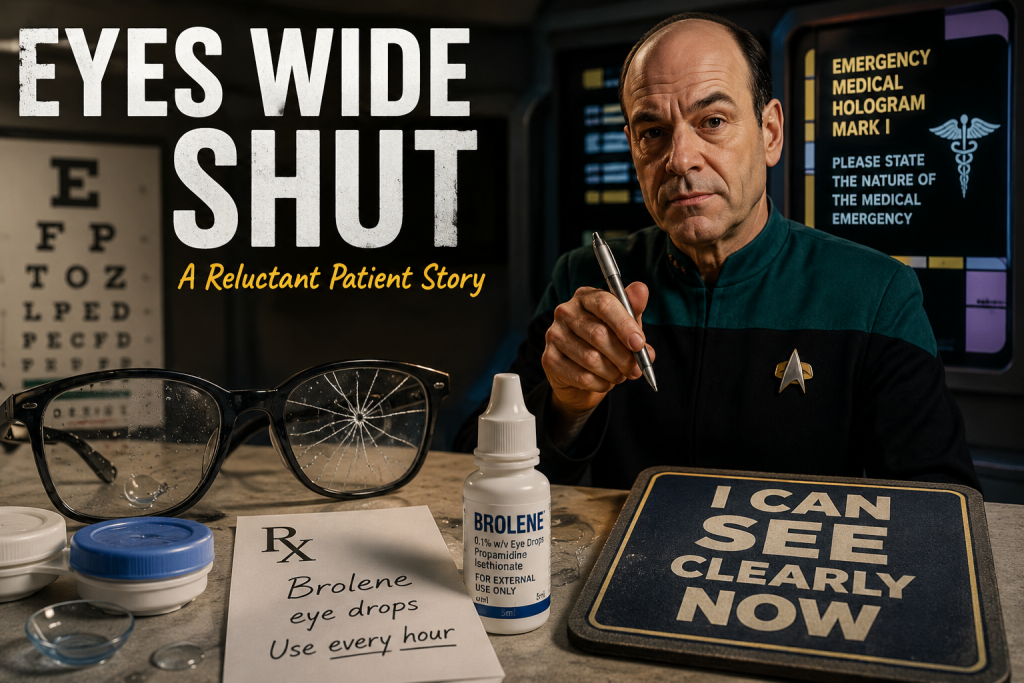
Waking up unable to see properly should probably be considered a medical emergency. It took me a little longer to reach that conclusion.