
Two numbers that are surprisingly difficult to measure properly — and mine have an irritating habit of being too high.
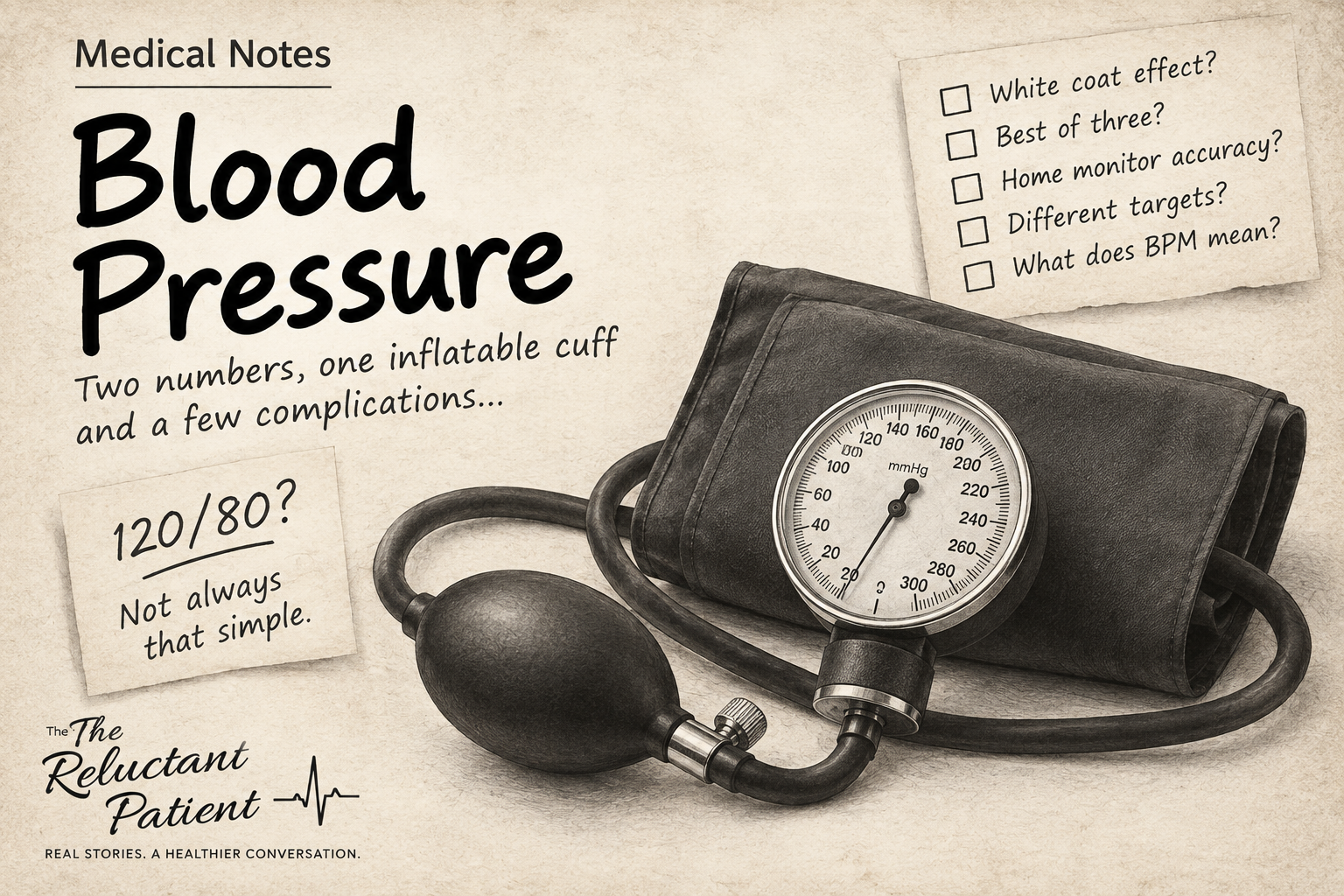
Blood pressure is the pressure of blood against the walls of your arteries as your heart pumps blood around your body.
A reading is given as two numbers, such as:
120/80 mmHg
The first is systolic pressure — the pressure when the heart pumps.
The second is diastolic pressure — the pressure when the heart relaxes between beats.
Simple.
Until you actually try measuring it.
Best of three?
Pretty much every time The Reluctant Patient has had his blood pressure taken, it hasn’t been taken once.
There are usually several attempts.
Hence, during The MoT, after another unimpressive result:
“Best of three?”
This was intended as a joke.
Unfortunately, repeated readings are actually part of measuring blood pressure properly.
The NHS says a blood-pressure test may be done a couple of times for accuracy. For home monitoring, readings are normally taken twice, at least a minute apart, in the morning and evening over several days. NICE uses the average of multiple readings when confirming or monitoring high blood pressure.
So perhaps:
Average of several?
Less funny.
More medically useful.
What about 120/80?
120/80 is probably the most famous blood-pressure reading in the world.
But there isn’t one magic number that’s perfect for everybody in every circumstance.
Current NHS guidance generally considers blood pressure high from 140/90 in a clinical setting, or 135/85 when measured at home. NICE treatment targets also vary according to factors including age and where the measurement is taken; for example, its targets change at age 80 rather than 50.
And recommendations aren’t carved in stone.
European guidance changed substantially in 2024, emphasising that cardiovascular risk from blood pressure exists on a continuum, rather than there being a simple dividing line between “normal” and “hypertension”.
So when a doctor recently told me that the traditional 120/80 thinking was being questioned and lower pressures may sometimes be desirable, there is a genuine evolving medical debate behind that conversation.
The important question isn’t simply:
“Am I above 120/80?”
It’s what the readings mean for you, consistently and in the context of your wider health.
White coat syndrome
Then there’s the slight problem that having your blood pressure measured can itself change your blood pressure.
Some people get higher readings in a medical setting than they do elsewhere — commonly called the white-coat effect.
Anxiety about the test, the surroundings or the person taking it can affect the result. NHS England specifically identifies avoiding this effect as one of the advantages of home monitoring.
Which creates a wonderfully circular problem:
Your blood pressure is high.
Oh God, my blood pressure is high.
Let’s measure it again.
Probably higher now.
I’ll do it myself
Home blood-pressure monitors can therefore be genuinely useful.
But that introduces some new variables.
Is the monitor accurate?
Is the cuff the right size?
Is it positioned properly?
Are you sitting properly?
Have you rested first?
Are you talking?
And, in The Reluctant Patient’s case:
Someone gave me this machine more than ten years ago. Is it still telling the truth?
Home monitors aren’t inherently second-rate — NICE actually uses home monitoring as part of diagnosing and managing hypertension — but the device needs to be validated and the technique needs to be right. NHS England recommends choosing a monitor validated for accuracy by the British and Irish Hypertension Society.
Perhaps I ought to check mine.
And what’s BPM?
My home monitor also displays BPM — beats per minute.
That’s my pulse rate: how many times my heart is beating each minute.
I’ve sometimes tried sitting quietly until my BPM comes down before pressing the button, in the hope that this will produce an impressively low blood-pressure reading as well.
It doesn’t necessarily work.
Heart rate and blood pressure are related to the cardiovascular system, but they’re not the same measurement. A slower pulse doesn’t automatically mean lower blood pressure.
So apparently I can’t game the machine that easily.
Why bother measuring it?
Persistently high blood pressure — hypertension — often causes no symptoms, but over time it can increase the risk of heart disease, heart attack, stroke, heart failure and kidney disease.
That’s why doctors kept commenting on mine even when I was there for something completely different.
It crops up before The MoT.
It crops up during The MoT.
And eventually Dr Archie decides that repeatedly observing:
“Your blood pressure is high.”
isn’t getting us very far.
That’s when the pills arrive.
But that’s another Case File.
From the Case Files
2.0.0 Hungover and Half Deaf
My blood pressure was already attracting unwanted attention.
4.0.0 The MoT
More blood-pressure readings. Still not winning at best of three.