
There are lots of reasons why you might not be able to hear properly. Some are easily fixed. Some need rather more urgent attention.
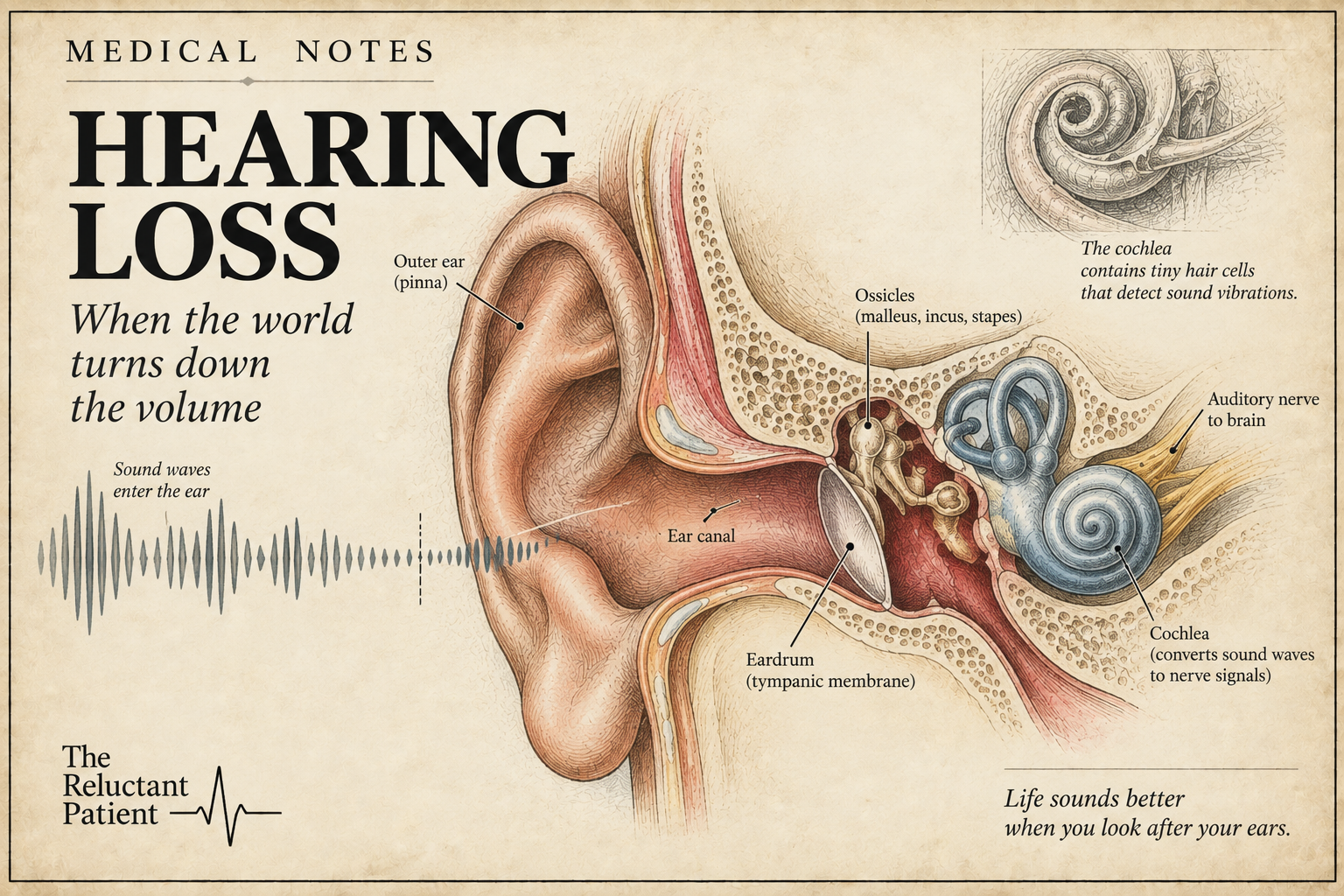
Hearing loss is a reduction in your ability to hear, which sounds simple enough.
The reasons for it are rather less simple.
It can happen gradually or suddenly. It can affect one ear or both. It can be temporary or permanent. And the problem can occur at several different points between a sound entering your ear and your brain eventually working out what it is.
The Reluctant Patient discovered this after a heavy night out.
I woke up almost completely deaf in one ear.
Sounds were muffled and distorted. Working out where sounds were coming from was difficult. My balance didn’t feel quite right either.
Naturally, I reached the obvious medical conclusion.
Earwax.
How hearing works
Very roughly, sound enters the outer ear and travels along the ear canal until it reaches the eardrum.
The sound makes the eardrum vibrate. Three tiny bones in the middle ear transmit those vibrations onwards to the cochlea in the inner ear.
Inside the cochlea, specialised sensory cells help convert those vibrations into electrical signals. Those signals travel along the auditory nerve to the brain, where they can finally be interpreted as speech, music, traffic, somebody calling your name or whatever else caused the disturbance.
There is therefore quite a lot that has to work properly.
In simplified Medical Notes terminology:
Sound → ear canal → eardrum → middle ear → inner ear → nerve → brain → “What?”
Where the problem occurs helps determine the type of hearing loss.
Conductive hearing loss
Conductive hearing loss happens when something prevents sound travelling efficiently through the outer or middle ear to the inner ear.
The inner ear itself may be perfectly capable of doing its job.
It just isn’t receiving the sound properly.
Common causes include earwax, infection, fluid in the middle ear and a perforated eardrum.
Which, rather conveniently, covers most of the suspects in Hungover and Half Deaf.
Suspect number one: earwax
Earwax is perfectly normal.
It’s produced in the ear canal and helps protect your ears. Usually it works its way out without anybody having to do anything about it.
Sometimes it builds up and blocks the ear canal.
That can cause hearing loss, a blocked sensation, earache, tinnitus and even dizziness.
So waking up unable to hear properly from one ear and concluding:
“Earwax.”
wasn’t completely ridiculous.
The Reluctant Patient acquired some ear drops.
Problem solved.
Except it wasn’t.
I used the drops and subsequently emptied my ear over the sink.
There was blood.
Ah.
That wasn’t part of the plan.
Suspect number two: a burst eardrum
At this point I remembered something else from the previous night.
I’d had a particularly violent coughing fit.
Could I have burst my eardrum?
A perforated eardrum is a hole or tear in the eardrum. It can cause hearing loss and symptoms can include pain, tinnitus, dizziness and fluid, pus or blood coming from the ear. Causes can include infection, injury, very loud noise and sudden changes in pressure.
Blood coming from an ear you’ve just discovered you can’t hear through is considerably more persuasive than the original earwax theory.
So this was the point where The Reluctant Patient stopped trying to solve the problem himself.
I contacted my GP.
The same day.
I’d like that noted for the record.
Sudden hearing loss
And this is actually important.
Sudden hearing loss shouldn’t simply be assumed to be earwax and ignored.
The NHS advises asking for an urgent GP appointment or contacting NHS 111 for sudden hearing loss in one or both ears. Hearing loss accompanied by symptoms such as earache or discharge from the ear also warrants urgent advice.
There is a particularly important reason for that.
Sometimes sudden hearing loss isn’t caused by a blockage or problem in the outer or middle ear at all.
It can be sudden sensorineural hearing loss.
Sensorineural hearing loss
Sensorineural hearing loss occurs when the problem involves the inner ear or the pathway carrying signals from it towards the brain.
It can have many causes. Ageing and prolonged exposure to loud noise are common causes of gradual sensorineural hearing loss.
But sensorineural hearing loss can also happen suddenly.
NICE treats sudden hearing loss developing over three days or less, where there isn’t an external or middle-ear explanation, as requiring immediate specialist assessment when it has occurred within the previous 30 days.
University Hospitals Sussex goes rather further in its patient information:
Sudden sensorineural hearing loss is a medical emergency.
Treatment may be time-sensitive, and delaying assessment can increase the risk that the hearing loss becomes permanent.
So while The Reluctant Patient eventually had a much less alarming explanation, somebody else waking up unexpectedly unable to hear shouldn’t assume:
“Mine is probably the same thing.”
Get it checked.
You don’t even need to put ear drops in first and produce blood.
So had I burst my eardrum?
No.
That theory was eventually ruled out too.
Not earwax.
Not a burst eardrum either.
Which was reassuring.
It did, however, leave us without an explanation.
The investigation continued through hospital appointments and ENT, with further examinations and treatment.
Eventually another suspect emerged.
Fluid.
Fluid in the middle ear
The middle ear is normally filled with air.
It connects to the back of the nose and throat through the Eustachian tube, which helps regulate pressure and allows fluid to drain.
If fluid collects in the middle ear, it interferes with the transmission of sound through the eardrum and middle-ear bones.
The result can be temporary conductive hearing loss.
A middle ear containing fluid rather than air isn’t going to transmit sound in quite the way it was designed to.
This is often known as middle-ear effusion or glue ear. It’s much more common in children, but adults can get it too. The NHS identifies temporary hearing loss as its main symptom.
And this was ultimately where my hearing problem appeared to lie.
The eardrum hadn’t exploded.
There wasn’t a great plug of earwax blocking everything.
There was fluid affecting how the eardrum was working.
The blood?
That remained something of a mystery.
Temporary or permanent?
This was the bit I actually cared about.
Was my hearing coming back?
The answer depends entirely on what’s causing the hearing loss.
Some conductive problems can be temporary. Earwax can be removed. Infections can be treated. Middle-ear fluid may clear.
Other forms of hearing loss can be permanent.
In my case, there were repeated appointments over the following months and further ear drops.
The improvement wasn’t instantaneous.
My hearing gradually improved and then, eventually, seemed to clear.
Which was an enormous relief.
There is something particularly unsettling about suddenly losing one of your senses when you’ve spent your life assuming it will simply be there tomorrow morning.
The Reluctant Patient would encounter that feeling again.
But that’s another Story.
One ear is surprisingly important
Losing hearing in one ear doesn’t simply mean everything becomes half as loud.
Two functioning ears help us work out where a sound is coming from.
The brain compares what arrives at each ear — including tiny differences in timing and volume — to help locate the source.
Take one ear substantially out of the equation and the world becomes rather less straightforward.
It can also become harder to understand speech, particularly when there is background noise.
That explains something I noticed immediately: I wasn’t merely struggling to hear.
I was struggling to work out where things were.
The ears, it turns out, work as a team.
Nobody had bothered to mention this while they were both functioning properly.
Hearing tests
If hearing difficulties aren’t explained by something obvious such as impacted earwax or an acute infection, NICE recommends audiological assessment and further diagnostic assessment where necessary.
A hearing test can measure how well someone hears sounds at different frequencies and volumes.
And this reveals another complication.
Hearing isn’t simply an on/off switch.
Someone can hear some frequencies better than others. They may be able to detect that somebody is speaking while struggling to distinguish the actual words, particularly in a noisy environment.
So:
“Can you hear me?”
may not have a straightforward yes-or-no answer.
The Reluctant Patient recommends asking again in a quiet pub.
Hearing aids
For permanent hearing loss, hearing aids can help make sounds louder and clearer, although they don’t restore hearing to normal. Other devices and implants may be appropriate for some kinds of hearing loss.
For many years, The Reluctant Patient’s principal education in hearing aids came from Mrs Richards in Fawlty Towers.
Basil asks why she doesn’t switch hers on.
She doesn’t want to wear the battery out.
An excellent way to preserve the battery.
There are drawbacks.
See Fawlty Towers (1975–1979) in the Waiting Room.
Looking after your hearing
Not all hearing loss can be prevented.
Ageing, genetics, illness and other factors can all play a part.
But repeated exposure to excessive noise can damage hearing permanently, so protecting your ears around very loud music, machinery and other noisy environments is worthwhile. The NHS also advises against listening to music excessively loudly.
Which is slightly awkward advice from a website with an entire section called Hospital Radio.
Turn it up.
Just not too far.
From the Case Files
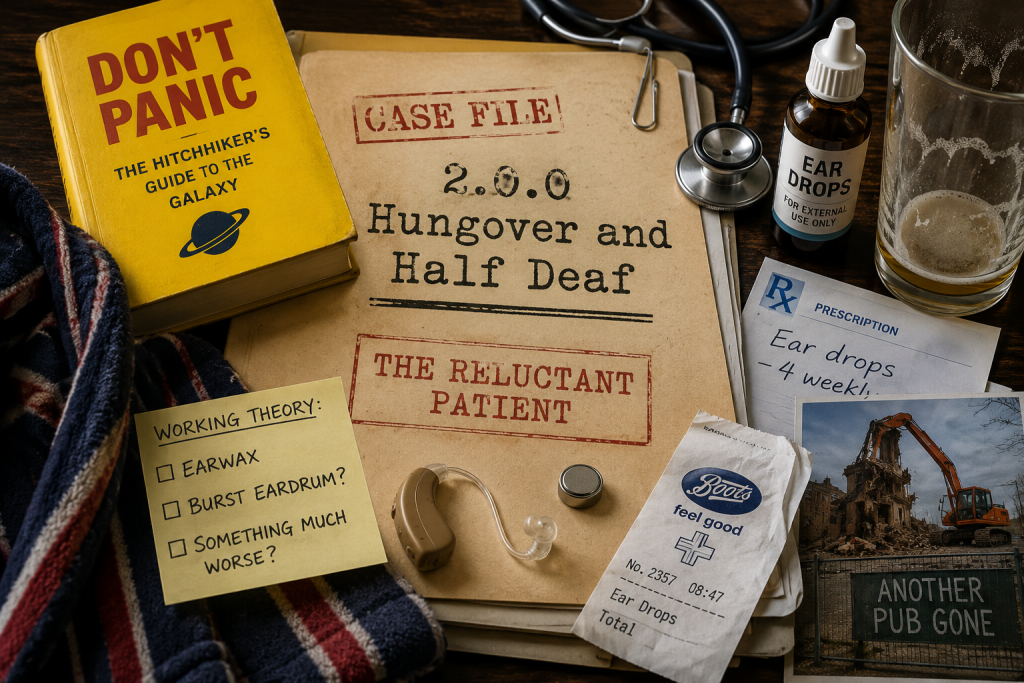
2.0.0 Hungover and Half Deaf
I woke up after a heavy night unable to hear properly out of one ear. Obviously, I assumed it was earwax. It wasn’t earwax.
In the Waiting Room
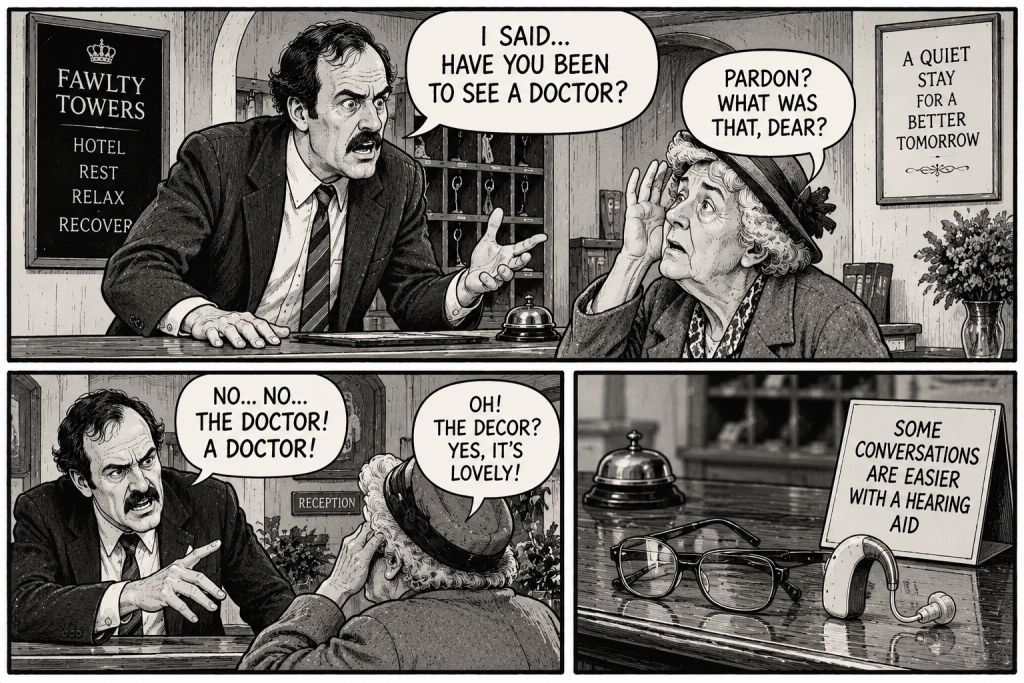
Fawlty Towers (1975–1979)
Perhaps Basil Fawlty should have listened to his doctors. The Reluctant Patient can see the problem with that immediately.
On Air: Hospital Radio

2.0.0 Hospital Radio: It’s Oh So Quiet
Björk, Kula Shaker, The Communards and Simon & Garfunkel. An unusually quiet Hospital Radio for a listener who can only hear half of it anyway.
Further information
I’d use these as the principal external sources:
University Hospitals Sussex — What to do if you have a sudden change in hearing