
Once known as the disease of kings. Now known as the reason even a bedsheet can become an instrument of torture.
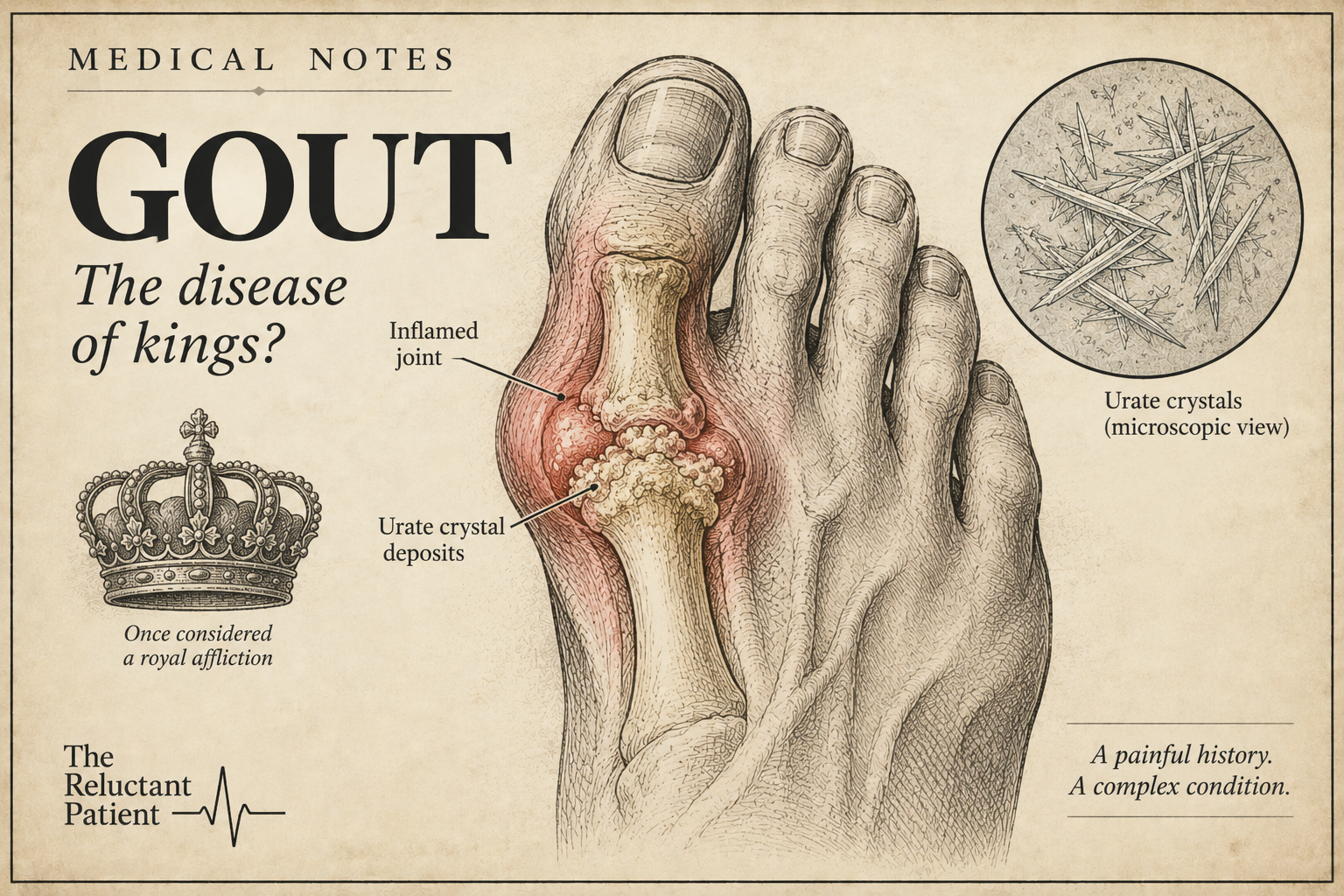
Gout is a form of inflammatory arthritis caused by tiny crystals of urate forming in and around joints, producing sudden attacks of severe pain and swelling.
The big toe is famously associated with it, but gout can affect other joints too, including elsewhere in the feet, ankles, knees, hands, wrists and elbows. Attacks often start suddenly and can be particularly troublesome at night.
In my case it was the foot.
And it hurt sufficiently badly that Google, a bloke down the pub and maybe, eventually, a medical professional would become involved.
My limited knowledge of gout at the time was historical rather than medical.
Something about kings.
Something about drinking too much.
And the Romans probably had something to do with it.
The disease of kings
Depending on your historical source, gout has been called the disease of kings, rich man’s disease or some variation on the theme.
The explanation seems obvious enough.
For much of history, the rich could afford considerably more meat and alcohol than everyone else. Gout became associated with an opulent lifestyle of rich food, plentiful wine and general overindulgence.
While the peasants presumably had the consolation of looking at the local lord with his swollen foot and thinking:
Serves you right.
There is some truth behind the stereotype. Alcohol, large meals and dehydration can contribute to gout and trigger attacks.
But it turns out that several thousand years of blaming the patient was a slight oversimplification.
Gout sometimes runs in families. Kidney problems, certain medicines and a number of other health conditions can increase the likelihood of developing it. Ultimately, the problem is about how much urate is in your blood and how effectively your body deals with it.
Your DNA may therefore have dealt some of the cards before you got anywhere near the wine list.
What have the Romans ever done for us?
Gout is hardly a modern complaint.
Something recognisable as gout was recorded by the ancient Egyptians thousands of years ago. In the fifth century BCE, Hippocrates described what we would recognise as gout affecting the big toe and called it the unwalkable disease.
That’s a pretty good description.
He also noticed its association with an affluent and intemperate lifestyle.
Several centuries later, the Roman-era physician Galen described tophi – deposits associated with longstanding gout – and also recognised both excessive living and heredity as possible factors.
So . . .
What have the Romans ever done for us?
The aqueduct.
Sanitation.
The roads.
Medicine.
Public health.
And gout?
Well, no. They didn’t actually give us gout.
Apparently the Egyptians had it first.
A drop in the joint
The word gout has an interesting history of its own.
It derives from the Latin gutta, meaning drop.
Medieval medicine was still working with the idea of four bodily humours, and gout was thought to result from an excess of one of them somehow dropping or flowing into the affected joint.
They were wrong.
But given what we now know was actually happening inside the joint, they weren’t entirely unreasonable in concluding that something deeply unpleasant had got into it.
So what actually causes gout?
This is where we have to do some science.
The body produces uric acid when it breaks down substances called purines. Purines occur naturally in our bodies and are also present in food and drink.
Uric acid circulates in the blood, predominantly as urate, and most of it is ultimately removed from the body through the kidneys and urine.
Usually, this arrangement works perfectly well.
Sometimes it doesn’t.
If the amount of urate in the blood remains too high, tiny crystals of monosodium urate can form in and around joints.
The crystals themselves aren’t merely uncomfortable foreign objects. Your immune system notices them and responds.
Enthusiastically.
The result is inflammation: pain, swelling, heat and redness.
Or, expressed in Medical Notes terminology:
Purines → uric acid/urate → too much urate → crystals → immune system gets involved → extremely objectionable foot.
Broken glass
When The Reluctant Patient first encountered gout, I didn’t know any of that.
I just knew it hurt.
A lot.
The closest description I can give is having broken glass inside the joint.
And I’m not the first person to struggle to describe quite how ridiculously painful gout can be.
The 17th-century English physician Thomas Sydenham knew the condition particularly well because he suffered from it himself.
He described an attack beginning during the night, often in the big toe, with the pain becoming progressively worse until even the weight of the bedclothes became intolerable.
Several hundred years later, the NHS still advises trying to keep bedclothes off an affected joint during an attack.
So we have made progress.
But apparently gout still wins arguments with duvets.
The Reluctant Patient conducts an experiment
Before understanding any of this, The Reluctant Patient accidentally discovered something.
Water.
Drinking a couple of pints of water seemed to make the pain considerably more bearable after the inevitable trip to the toilet.
Whether those two events were connected quite as directly as I imagined is another matter.
But avoiding dehydration is sensible with gout, and NHS advice during an attack includes drinking plenty of water unless you’ve been told by a doctor not to.
So the experiment wasn’t entirely without merit.
It just wasn’t exactly peer reviewed.
Painkillers
Then there are painkillers.
Gout isn’t merely painful; it’s an inflammatory condition. NSAIDs – Non-Steroidal Anti-Inflammatory Drugs — such as ibuprofen are commonly used to treat gout attacks.
The Reluctant Patient had previously found ibuprofen rather effective.
Unfortunately, I subsequently acquired prescribed medicines whose information and medical advice suggested that NSAIDs were something I should be more careful about.
Which left paracetamol – and, on one memorable occasion, Panadol Extra – trying to fight a battle for which ibuprofen had previously seemed rather better equipped.
This is one of those occasions where reading the leaflet and checking with a pharmacist or medical professional is considerably more sensible than copying The Reluctant Patient.
See also: Ibuprofen, NSAIDs and Paracetamol in the Medical Notes.
Bloody hell, there really are crystals in it
Medicine eventually moved beyond blaming kings for eating too much.
In 1679, Dutch microscopist Antonie van Leeuwenhoek examined material from a gouty deposit and described long, pointed crystalline structures.
He could see them.
He just didn’t yet know what they were made of.
In 1776, Swedish chemist Carl Wilhelm Scheele identified uric acid in a urinary stone.
Then, in 1797, English chemist William Hyde Wollaston demonstrated urate in a gouty deposit.
Taken from his own ear.
The Reluctant Patient respects his commitment to primary-source research.
The English get involved
Obviously, this is where everything became much clearer.
Unfortunately, we’ve already had to admit that a Dutchman found the crystals and a Swede identified uric acid.
But never mind.
In the 19th century, English physician Alfred Baring Garrod demonstrated that people with gout had increased uric acid in their blood and developed an early clinical test for measuring it.
More importantly, he argued that deposited urate was the cause of gouty inflammation rather than simply something produced as a consequence of it.
The pieces were finally coming together.
Ancient Egyptians: We’ve seen this.
Hippocrates: You can’t walk, can you?
Romans: Probably all that excess. Also, it might run in families.
Medieval physicians: Something has dropped into your foot.
1679: Bloody hell, there are crystals in it.
19th-century medicine: Uric acid.
21st-century Reluctant Patient:
Google and a bloke down the pub.
Progress.
So is it caused by drinking and rich food?
Not exactly.
Food and alcohol haven’t been completely acquitted.
Drinking too much alcohol, eating a very large meal and becoming dehydrated can trigger gout attacks. Being overweight can increase your chances of developing gout too.
But that’s very different from saying:
You have gout because you ate and drank too much.
Some people are genetically more susceptible. Gout can run in families. Kidney problems can affect the body’s ability to remove urate. Certain medicines can increase the risk, including some diuretics and medicines used for high blood pressure. Other health conditions are associated with an increased likelihood of gout as well.
The historical stereotype therefore contains a grain of truth wrapped in a very large helping of oversimplification.
Which is probably true of quite a lot of medical advice given over the last few thousand years.
What can be done about it?
There are really two different jobs.
The first is dealing with the attack happening now.
Treatment can include anti-inflammatory medicines such as NSAIDs. Other treatments, including steroids and the prescription medicine colchicine, may be used depending on the circumstances and what is suitable for the individual patient. Resting and raising the affected limb, keeping the joint cool and drinking plenty of water can also help.
The second job is trying to stop gout repeatedly coming back.
For people with frequent attacks or persistently high uric acid levels, doctors may prescribe medicines that lower uric acid. Allopurinol is one example. Lifestyle changes and avoiding dehydration can also form part of prevention.
That’s a conversation to have with a medical professional rather than The Reluctant Patient.
Especially since it took him this long to get one involved.
When to seek medical help
If you think you’re experiencing gout for the first time, the NHS recommends seeing a GP rather than relying on Google, a bloke down the pub or this website.
There’s also an important reason not to assume that every suddenly painful, swollen joint is gout.
A joint infection can cause similar symptoms and needs urgent medical attention. The NHS advises seeking urgent help if sudden joint pain and swelling are getting worse and you also have a very high temperature, feel hot, cold or shivery, feel sick or cannot eat.
See?
Eventually we got a medical professional involved.
From the Case Files
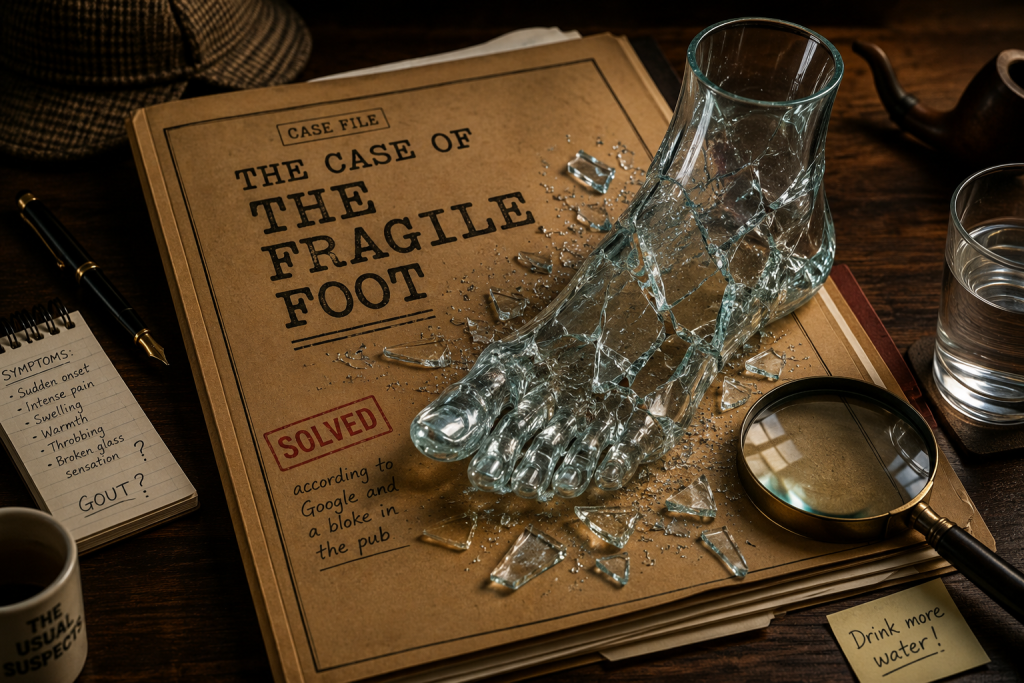
1.0.0 The Case of The Fragile Foot
A mysterious pain in my foot calls for expert medical advice. So naturally, I turn to Google and a bloke down the pub.