
Doctors keep asking how many units of alcohol I drink. It turns out “a pint” isn’t actually an acceptable unit of measurement.
Whenever a medical professional asks about alcohol, sooner or later this question appears:
“How many units do you drink a week?”
This sounds straightforward.
I know how many pints I’ve had.
I know whether I’ve had wine.
I can probably remember the whisky.
What I don’t routinely do is convert the evening into units.
Unfortunately, that’s the number they’re actually asking for.
So what is a unit?
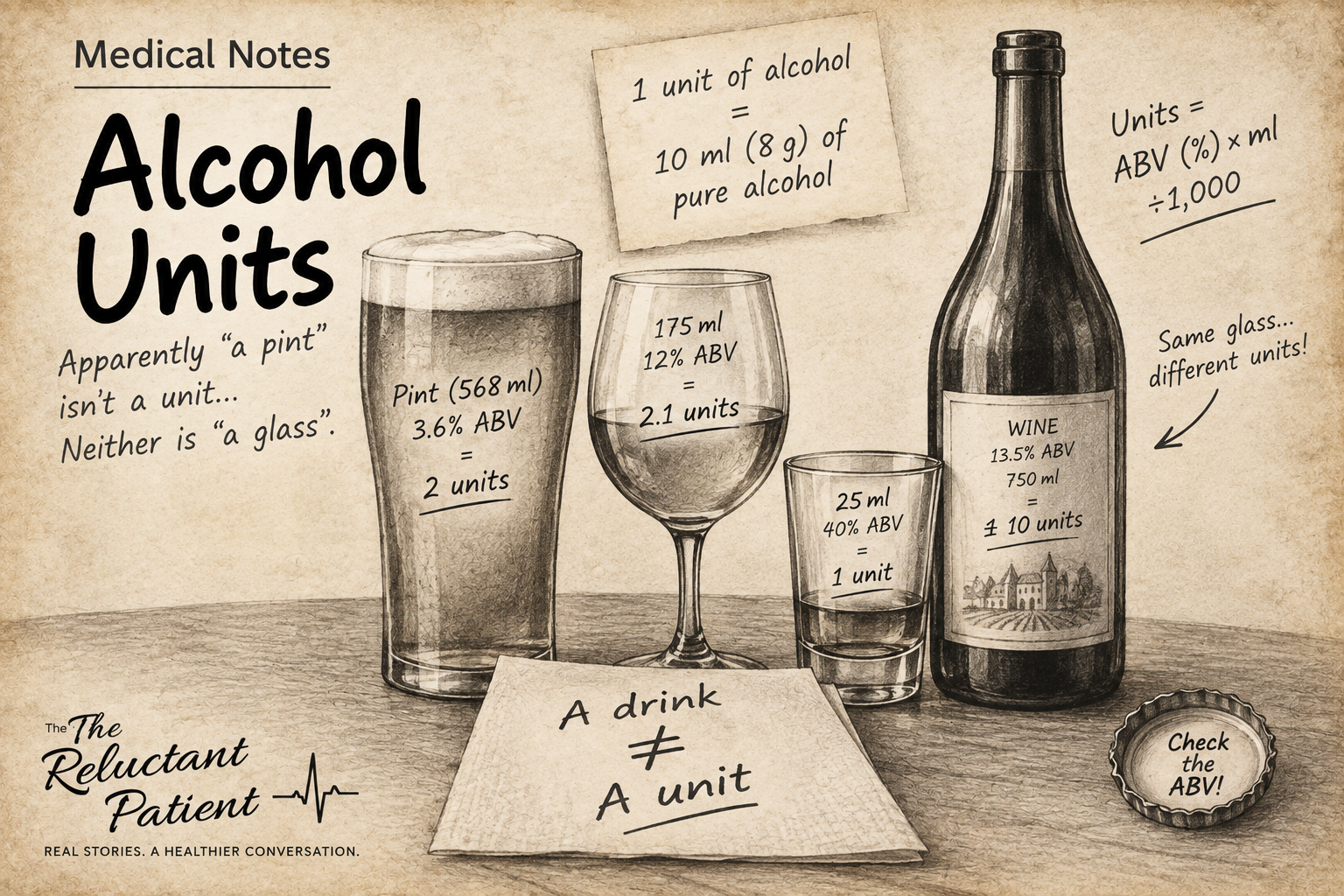
In the UK, one unit of alcohol is 10 ml — or 8 grams — of pure alcohol.
It’s a way of comparing drinks of different strengths and sizes.
Which is important because:
one drink does not equal one unit.
Not even close, sometimes.
A pint isn’t a unit
A pint is a measure of liquid.
A unit is a measure of the alcohol in it.
So two identical pint glasses can contain quite different numbers of units.
According to the NHS:
Pint of 3.6% beer = about 2 units
Pint of 5.2% beer = about 3 units
Same amount of liquid.
About 50% more alcohol.
This is where answering:
“About six pints.”
doesn’t actually answer the doctor’s question.
Six pints of what?
ABV
Fortunately, bottles, cans and usually pumps tell us how strong the drink is.
That’s the ABV — Alcohol By Volume.
A drink marked:
5% ABV
contains 5% pure alcohol by volume.
And if you really want to calculate the units yourself, there’s a formula:
ABV × volume in ml ÷ 1,000 = units
So a pint — 568 ml — of 4% beer is:
4 × 568 ÷ 1,000 = 2.27 units
Obviously.
That’s exactly the calculation I perform every time somebody puts a pint in front of me.
Wine makes things more interesting
Wine demonstrates the problem particularly well because there’s no such thing as simply “a glass”.
Using 12% wine:
125 ml = 1.5 units
175 ml = 2.1 units
250 ml = 3 units
And that’s before somebody pours one at home.
“One glass.”
Yes.
How big was the glass?
And how much did you put in it?
A standard 750 ml bottle of 13.5% wine contains about 10 units.
Suddenly “we shared a bottle” is rather more useful information than “I had a couple of glasses”.
Spirits are easier. Sort of.
A 25 ml measure of 40% spirits is exactly:
1 unit.
Excellent.
We’ve finally found a drink that behaves itself.
Except some pubs use 35 ml measures, which makes the same 40% spirit 1.4 units.
And then there are doubles.
And generous measures at home.
Back to the calculator.
What’s this 14 units I keep hearing about?
Current UK Chief Medical Officers’ guidance says that, to keep the health risks from alcohol at a low level, it is safest for both men and women not to regularly drink more than 14 units a week.
If you regularly drink as much as 14 units, the advice is to spread them over three or more days, rather than saving them up for one or two sessions.
Fourteen units is roughly equivalent to six pints of average-strength beer, although once again the actual number depends upon its strength.
Importantly, 14 isn’t a magic safety line.
The guidance describes it as low risk, not no risk. The health risks from regular drinking increase as consumption increases.
So how many units do I drink?
And this is where the doctor’s apparently simple question becomes rather more awkward.
To answer it properly, I need to know:
what I drank;
how much of it I drank;
how strong it was;
and ideally:
remember all of that over an entire week.
Then perform some arithmetic.
When somebody asks:
“How many units do you drink?”
what I actually know is:
“I went to the pub on Tuesday.”
There may be some follow-up questions.
Why do they keep asking?
Because the number gives medical professionals something more useful than simply knowing that somebody drinks “beer”, “wine” or “occasionally”.
Ten pints of low-strength beer and ten pints of strong beer aren’t the same alcohol intake.
Nor are ten small glasses of wine and ten large ones.
Units provide a common measurement.
They’re particularly useful when alcohol might be relevant to other things going on medically.
Which is why The Reluctant Patient has been asked about them rather a lot.
From the Case Files
4.0.0 The MoT
A routine health check involves questions about smoking, drinking and assorted other lifestyle choices before the blood tests provide a rather more interesting answer.